



The stone owl carved into a buttress of the Notre-Dame church, in the 15th century, has become Dijon’s most followed tour guide without ever meaning to. Since 2001, the tourist office has marked the historic centre with 16,000 bronze plaques shaped like arrows, each stamped with the owl’s likeness, tracing a 22-stop route through the protected old town. Most write-ups stop at that number without ever saying what there actually is to see at each stop. Here is the detail, stop by stop, with real walking and cycling times, and the budget depending on whether you stop everywhere or just follow the arrows on the ground.
The 22 stops of the historic loop, one by one
The route covers roughly 3 kilometres through the protected district and loops back on itself: you can join it from any point in the city centre, in either direction. The order below follows the sequence most commonly documented by guides who have walked the circuit booklet in hand, from Jardin Darcy to Saint-Bénigne Cathedral.
- Jardin Darcy - the classic starting point, a 19th-century park with ponds and the Pompon bear statue, laid out around the water system engineered by Henry Darcy.
- Grand Hôtel de la Cloche - a grand hotel with bell-carved windows, saved from demolition in the 1970s and now a listed building.
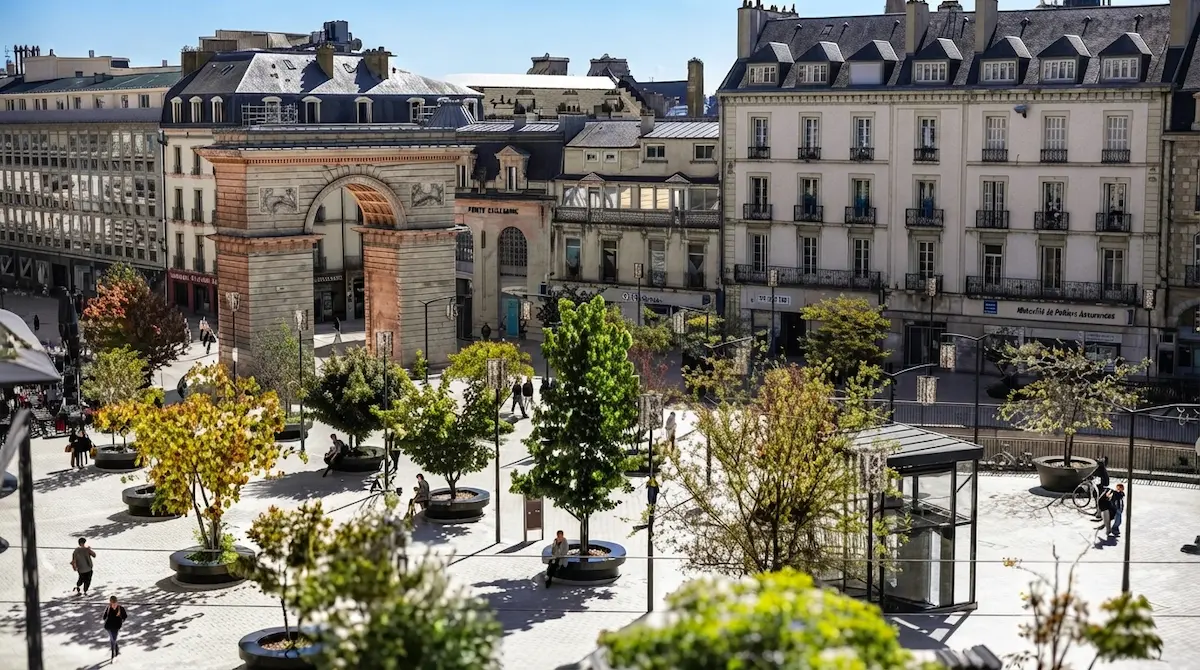
- Porte Guillaume - an 18th-century triumphal arch that replaced the old medieval fortified gate, one of the last remnants of the city walls.
- Post office, Place Grangier - a corner building with an Art Nouveau roofline, a landmark before entering the shopping streets.
- Les Halles - the iron-framed covered market, which narrowly escaped demolition in the 1970s: a good spot for a snack break.
- Place François-Rude - the liveliest square in the centre, with its fountain and statue of the grape-treader (le Bareuzai), craft market on Sundays.
- Rue des Forges - a street lined with private mansions from the Middle Ages to the Renaissance, including Hôtel Aubriot and Maison Maillard.
- Notre-Dame church - the 13th-century Gothic façade, its gargoyles and its jacquemart, the famous automaton clock.
- The owl - the carving itself, on the church’s north buttress, stroked with the left hand while making a wish.
- Maison Millière - a timber-framed house from 1483, one of the oldest shop fronts in Dijon, now a tea room.
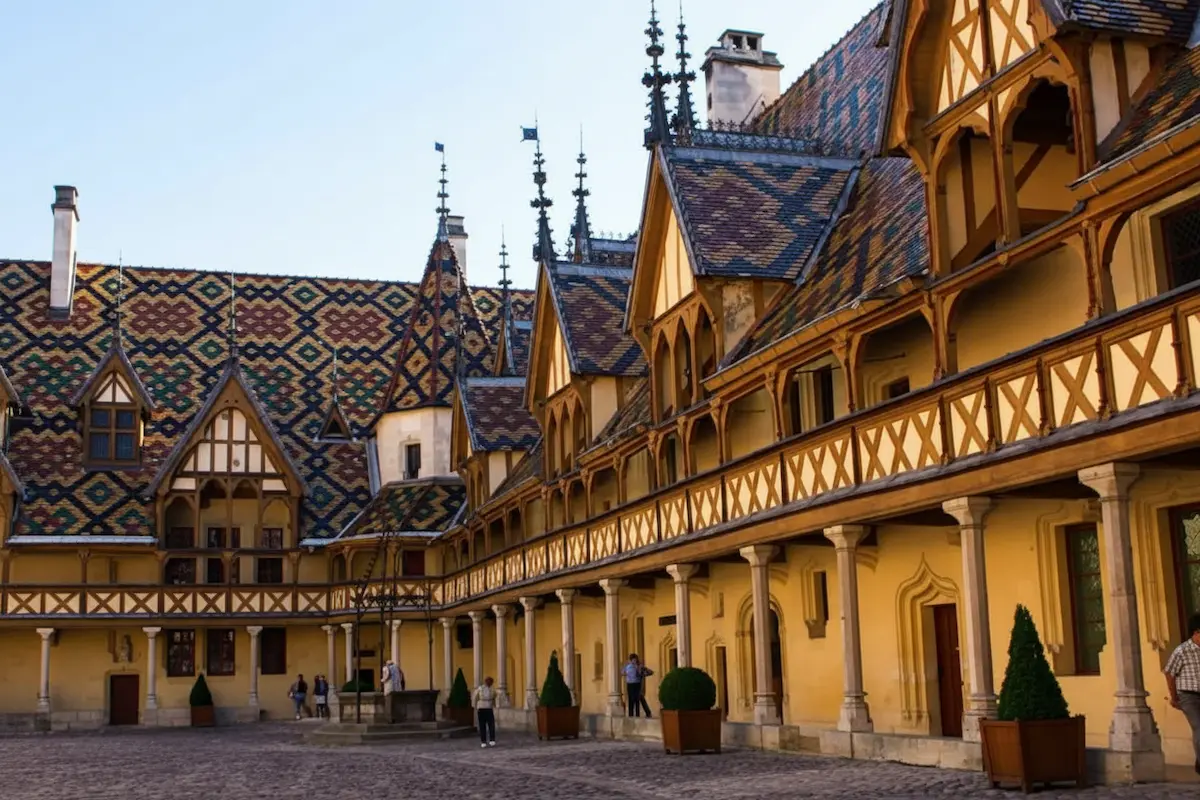
- Hôtel de Vogüé - a 17th-century mansion with a typically Burgundian glazed-tile roof, now hosting exhibitions and concerts.
- Place du Théâtre - the Grand Théâtre and the Musée Rude (free entry), dedicated to Dijon-born sculptor François Rude.
- Place de la Sainte-Chapelle - the entrance to the Musée des Beaux-Arts, housed in the former ducal palace, free entry.
- Square des Ducs - a small garden behind the palace, with a view of the Tour Philippe le Bon, another spot to catch your breath with children.
- Palace of the Dukes and Estates of Burgundy - the 14th-century seat of ducal power, today town hall and museum, where two of the four Valois dukes of Burgundy are buried.
- Tour Philippe le Bon - 46 metres and a long flight of steps, the only paid stop on the trail, with views over the glazed-tile roofs.
- Place de la Libération - the 17th-century semi-circular square designed by Mansart, with its terraces and fountain, one of the finest royal squares in France.
- Palais de Justice - the former Parliament of Burgundy from the 16th century, whose interior is occasionally open via the tourist office.
- A bourgeois townhouse - the trail passes one of roughly 75 private mansions marked with a plaque in the historic centre, with its inner courtyard.
- Saint-Jean church and Place Bossuet - a former 14th-15th-century Gothic church, now converted into a theatre, on a square with a statue of Bossuet.
- Saint-Philibert church - an 11th-12th-century Romanesque church, deconsecrated since the Revolution and for a time used as a warehouse.
- Saint-Bénigne Cathedral - the Gothic cathedral dedicated to the 1st-century martyr, topped by the city’s tallest bell tower and a glazed-tile roof.
Following the arrows with children
The format works particularly well for a family outing, precisely because it doesn’t feel like a formal guided tour. Hunting for the next arrow set into the pavement turns into a treasure hunt that children follow with far more enthusiasm than a straight history lesson. Nothing stops you sitting on a bench, taking a break at Jardin Darcy (stop 1) or Square des Ducs (stop 14), or cutting the loop short if attention spans run out. The district is entirely pedestrian, with no traffic to watch for.
The one thing to know before setting off with a stroller: the paving. It’s mostly fine, but some stretches, especially around the medieval lanes and Place François-Rude (stop 6), are uneven. A stroller with large wheels copes without trouble; an umbrella stroller will bounce more on the older sections.
Real duration and budget
On foot and by bike
On foot, allow about one hour for the 22 stops of the main loop, at a strolling pace, without going into any museum. With a full visit of the Musée des Beaux-Arts and a climb up the Tour Philippe le Bon, the same loop takes closer to 2h30 to 3h.
By bike, the trail’s 3 kilometres can be pedalled in 15 to 20 minutes on the clock. But that figure is misleading: the protected district is largely pedestrian, with narrow, cobbled streets ill-suited to a bike that stops every hundred metres to read a plaque. Cycling is mainly useful for scouting the route once before coming back on foot, or for linking the historic centre to the more distant extensions like the Puits de Moïse.
On the free loop
Staying on the 22 marked stops without going into anything, the visit costs nothing. Most of the museums along the way - Musée des Beaux-Arts (stop 13), Musée Rude (stop 12) - are free to enter, like most of Dijon’s municipal museums.
With every paid stop
The only genuinely paid stop on the main trail is the Tour Philippe le Bon (stop 16), booked at the tourist office (prices on destinationdijon.com). Add the printed guidebook or mobile app, a few euros more, if you’d rather have detailed commentary than follow the arrows by instinct. For a family of four climbing the tower and buying the booklet, budget roughly fifteen euros in total - time remains by far the bigger cost, not money.
What most visitors miss: the three loops added in 2011
This is where a deeper visit of the Owl Trail really pays off. Ten years after the historic circuit was created, the tourist office added three secondary loops totalling 15 extra stops. They don’t always make it into quick tourist round-ups, even though they cover districts and monuments the 2001 trail left out. Combined with the main circuit, they push the total walk to 5-6 kilometres and 3 to 4 hours, according to visitors who did the whole thing in one go.
The Jean-Jacques Rousseau loop
This extension pushes into the medieval heart of the historic centre, in what is now the antiques quarter. The documented route follows Rue Verrerie, lined with half-timbered houses typical of the Middle Ages, then Rue Auguste-Comte and Rue Jean-Jacques-Rousseau, where the Tour Saint-Nicolas, remnant of a former church, still stands. It passes Place de la République and its monument to Sadi Carnot, then Rue Vannerie, lined with Hôtel Cœurderoy, Hôtel Chartraire de Montigny and the former military command building. It continues along Rue d’Assas and the small Place Garibaldi, then Rue Chaudronnerie, home to the 16th-century Maison des Cariatides, before rejoining the main trail via Rue Lamonnoye.
The Zola loop
The second loop crosses a later residential district, just off the most photographed monuments. It passes Place Émile-Zola and its frog-decorated pond, Rue Charrue with its carved façades, Place des Cordeliers and Hôtel Gauthier, then the Sainte-Anne quarter and the former Carmelite convent church. It crosses Jardin Victor-Dumay and Jardin Jean-de-Berbisey, runs along Rue Monge and Hôtel Bouchu dit d’Esterno, before circling back to Saint-Jean church (stop 20 on the main trail) and Place Bossuet, rejoining Saint-Bénigne Cathedral.
The Puits de Moïse and the Chartreuse de Champmol
The third extension is by far the richest historically, and the furthest away: it leads to the Parc de l’Arquebuse then on to the Chartreuse de Champmol, a former monastery dismantled during the Revolution, of which only two major elements survive, the church portal and the Puits de Moïse (Well of Moses). This work, carved by the Flemish sculptor Claus Sluter at the end of the 14th century, originally featured six statues of prophets - David, Moses, Isaiah, Daniel, Zechariah and Jeremiah - at the centre of the charterhouse’s great cloister. Art historians rank it among the pivotal works between late Gothic and Renaissance sculpture, for the precision of its expressions and the treatment of its drapery. Access is free, from the courtyard of what is now a hospital complex, no ticket required. It’s a stop worth a dedicated detour that the 22-stop historic loop never offers.
For a family, stringing together all 37 stops in a single outing is ambitious with young children: better to save the 22-stop historic loop for one morning, then come back another day for the Puits de Moïse, which pairs well with a walk in the neighbouring Parc de l’Arquebuse.
Practical information
The trail is free and open at any hour, since it’s simply plaques set into public pavement, with no ticket and no opening times. No booking is needed, and it works just as well solo as in a group or with the family. The best season is spring or early autumn, when the city-centre terraces allow a mid-route break without the heat or crowds of high summer.
The only real cost, besides the Tour Philippe le Bon, is the guide itself: the printed booklet detailing every stop is sold at the Dijon Métropole tourist office, 11 Rue des Forges. For a digital guide, a dedicated Owl Trail app is available on the App Store and Google Play, for a few euros, with content equivalent to the booklet.
Frequently asked questions
How long does the Owl Trail take?
Is the Owl Trail stroller-friendly?
Is the Owl Trail free?
Another question?
Write to usSources
- Bourgogne Tourisme - Parcours de la Chouette
- JDS.fr - La Chouette de Dijon : histoire, parcours, adresse, application
- La Côte d'Or J'adore - Parcours de la Chouette
- La Côte d'Or J'adore - Le puits de Moïse
- Paris la Douce - Le parcours de la chouette, itinéraire touristique insolite à Dijon
- Drôle de Voyage - La chouette de Dijon : histoire, légendes et parcours touristique
- Destination Dijon (tourist office) - Le Parcours de la Chouette (The Owl Trail)
- Dabbling in Jet Lag - The Dijon Owl Trail: A Complete Guide
- Offbeat France - Visiting Dijon? Let the Dijon Owl Trail Guide You
- Les escapades de Sodisabi - Le Parcours de la Chouette et les boucles Zola et Rousseau