









In short: Côte-d’Or is a very different trip depending on who’s travelling. A cyclist doesn’t follow the same route as a couple on a weekend away, and a parent with children doesn’t need the same things as a hiker in the Morvan. This guide sorts the possible itineraries by profile, each with a concrete starting point.
Côte-d’Or isn’t a vast territory: Dijon and Santenay, at either end of the vineyard, are barely sixty kilometres apart. But the sheer density of things to do there, between vineyards, the forests of the Auxois and the Morvan, heritage towns and producer markets, makes choosing an itinerary trickier than it looks. This guide sorts seven ways to approach the department depending on what you’re after: alone, as a couple, with the family, on foot, by bike, around the table, or for the heritage. Each profile has its own places and constraints, covered in dedicated guides elsewhere on this site; this page is an entry point for getting your bearings before you dig in.
Travelling alone in Côte-d’Or
Travelling alone in Côte-d’Or has one clear advantage: flexibility. No one to consult before deciding to linger an extra hour in a cellar or cut a hike short. Dijon works well as a fixed base for a solo trip: the city is easy to cover on foot, the Halles centrales serve as a daily go-to for a quick bite, and train links to Beaune (under 30 minutes) allow day trips without a car. The solo pace also suits visits that require flexibility, such as an impromptu tasting at a cellar that will take a lone visitor without a group booking, or a whole morning spent in a museum with no schedule to negotiate.
One thing to watch for: some activities in the department, especially cellar tastings and gastronomic restaurants, are built for groups of two or more, with pricing or formats that penalise a solo visitor. Checking ahead of booking avoids unpleasant surprises.
Weekend for couples
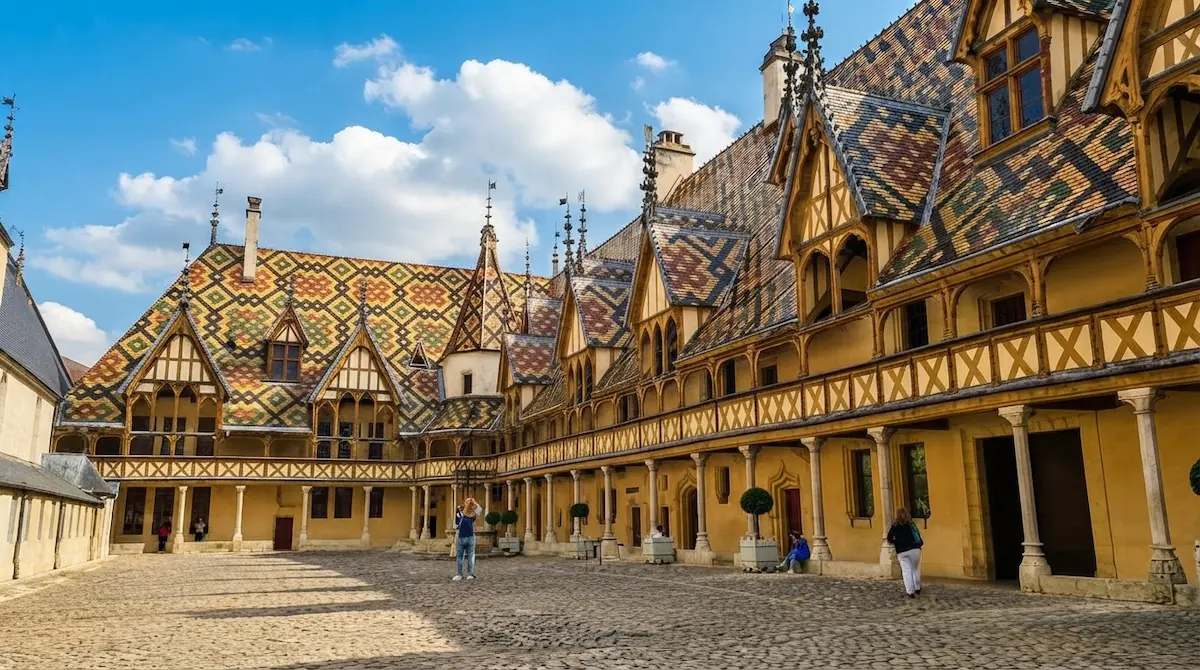
The most requested trip format in the department is still the couple’s weekend, and Côte-d’Or has enough to fill one without overloading it. Beaune packs the essentials into a compact town centre: the Hospices, dinner at a gastronomic address, a walk along the ramparts. Around it, the villages of the Route des Grands Crus (Gevrey-Chambertin, Vosne-Romanée, Meursault) offer guesthouses set right in the vineyard, where the setting does part of the work. For a weekend that strays further off the beaten path, Semur-en-Auxois or Flavigny-sur-Ozerain, further north-west, add a medieval feel less than an hour’s drive away.
One thing to plan for: Beaune’s best tables and most sought-after rooms get booked weeks ahead starting in spring, especially around the Trois Glorieuses period (the Hospices wine auction, third weekend of November).
Family trips with children
Travelling in Côte-d’Or with children shifts the priorities: less time in cellars, more time outdoors, and visits that tolerate a bit of impatience. The MuséoParc Alésia, near Venarey-les-Laumes, works well for this audience thanks to its interactive trail on the battle between Caesar and Vercingetorix. The Voie des Vignes cycle route (see below) also suits a family outing very well: the route is flat, safe, and dotted with villages to stop in. Dijon, meanwhile, offers several parks (parc de la Colombière, jardin de l’Arquebuse) to breathe between two heritage visits.
Best avoided with young children: the Philip the Good tower in Dijon (316 steps, no lift) and the Morvan’s long hikes without a short stage planned in advance.
Hiking: the Auxois and the Morvan
Two ranges share hiking in Côte-d’Or, and they don’t look alike. The Auxois, in the north-west of the department, alternates limestone hills, prehistoric sites (Alésia) and hilltop villages like Châteauneuf-en-Auxois: routes of several hours, with no extreme elevation gain, manageable for occasional hikers. The Morvan, further south-west, is a more demanding forested range, with lakes (Settons, Pannecière) and real terrain to contend with.
The Tour du Morvan, for committed hikers
The GR® de Pays Tour du Morvan, a loop starting at Ouroux-en-Morvan, runs for 230 km and represents around 60 hours of walking, rated difficult by the Parc naturel régional du Morvan. A shorter, more recent variant, the Tour du Morvan des Sommets, covers 137 km over 7 stages of around 20 km each, across 12 rural communes; its route was tested with residents before its public launch in 2023.
For a shorter outing
Without going for a full GR, the Auxois lends itself to half-day loops between Semur-en-Auxois, Flavigny-sur-Ozerain and Bussy-Rabutin, doable without special gear or lengthy preparation.
By bike: the Voie des Vignes, the signature itinerary
The route, from Marsannay to Santenay and Nolay
The Voie des Vignes is the department’s best-known cycle route: 67 km of greenway, mostly on a dedicated track, between Marsannay-la-Côte (on Dijon’s doorstep) and Santenay, according to the official route mapped by the Département de la Côte-d’Or. Total elevation gain stays low, around 500 metres, over the full route, making it accessible to an unfit cyclist or a family. A 14 km extension continues the route from Santenay to Nolay, 9 km of it on a former railway line (7 km of that section already lies in Saône-et-Loire).
Splitting the route into stages
The route naturally breaks into three sections of about twenty kilometres each: Dijon to Nuits-Saint-Georges, Nuits-Saint-Georges to Beaune, then Beaune to Santenay. Allow two to three days for the full route at an easy pace with tasting stops, or a single long day for a fit cyclist wanting to link both ends.
The Route des Grands Crus, for extending the trip by car or motorbike
For those who prefer a car, the Route des Grands Crus runs along a parallel but longer route: 60 km between Dijon and Santenay, through 37 wine villages, marked by its distinctive brown signage with a white grape cluster. It’s the oldest wine route in France, created in 1937.
Food: from markets to cellars
Markets, for understanding the terroir before tasting it
A market is the best starting point for grasping what the department produces before sitting down to eat or heading into a cellar. Dijon’s Halles centrales, built between 1873 and 1875, open their stalls Tuesday, Thursday, Friday and Saturday from 7am to 1pm; in Beaune, the Saturday morning market (8am-noon) brings together around 180 traders around the place de la Halle, with fruit and vegetables, cheese and rotisserie stalls.
From cellar to table
The logical next step from the market is the cellar: both the Route des Grands Crus and the Voie des Vignes pass through villages where estates open their doors for tastings, often by appointment. Unlike a market, a cellar visit takes planning ahead: many well-known estates operate by appointment only and turn away last-minute visitors in high season (the harvest, the Trois Glorieuses weekend).
Culture and heritage
Côte-d’Or packs a dense heritage into a compact area: Dijon’s historic centre, the Hospices de Beaune, and a UNESCO World Heritage site, the Abbaye de Fontenay, founded in 1118 by Saint Bernard of Clairvaux and inscribed in 1981, one of the very first French sites on the UNESCO list. Further north-west, the Alésia site rounds out this heritage base with its archaeological and Gallo-Roman dimension.
A pure heritage itinerary can stick to Dijon and Beaune over two to three days, or extend into the Auxois to take in Fontenay and Alésia over a week-long stay.
Choosing your itinerary
What these seven profiles have in common: none of them covers the whole department. Côte-d’Or rewards a focused choice over a rushed overview. One figure gives a sense of how much appetite there currently is for the destination: the department recorded the strongest growth in the Bourgogne-Franche-Comté region for tourist overnight stays in 2025 (+8.6%), with close to a third of the region’s total on its own, according to Insee. Worth bearing in mind when booking, especially in high season and around the Trois Glorieuses weekend.
Frequently asked questions
How many days do you need to see Côte-d'Or?
Can you visit Côte-d'Or without a car?
What's the best time of year to cycle the Voie des Vignes?
Do you need to book cellar visits in advance?
Are the Morvan and the Auxois suitable for families with children?
Another question?
Write to usSources
- France Vélo Tourisme - La Voie des Vignes by bike
- Route des Grands Crus de Bourgogne - La Voie des Vignes by bike
- Département de la Côte-d'Or - La Voie des Vignes
- Beaune et le Pays Beaunois Tourisme - A ride on the Route des Grands Crus
- Parc naturel régional du Morvan - GR de Pays Tour du Morvan
- Beaune et le Pays Beaunois Tourisme - Beaune market
- Ville de Dijon - Trade and craft, the Halles market
- Insee Flash Bourgogne-Franche-Comté n°229 - Summer 2025 tourism figures
- Wikipedia (FR) - Abbaye de Fontenay
- Wikipedia (FR) - Halles centrales de Dijon
- Bibracte - Le Tour du Morvan des Sommets, a new hiking route