
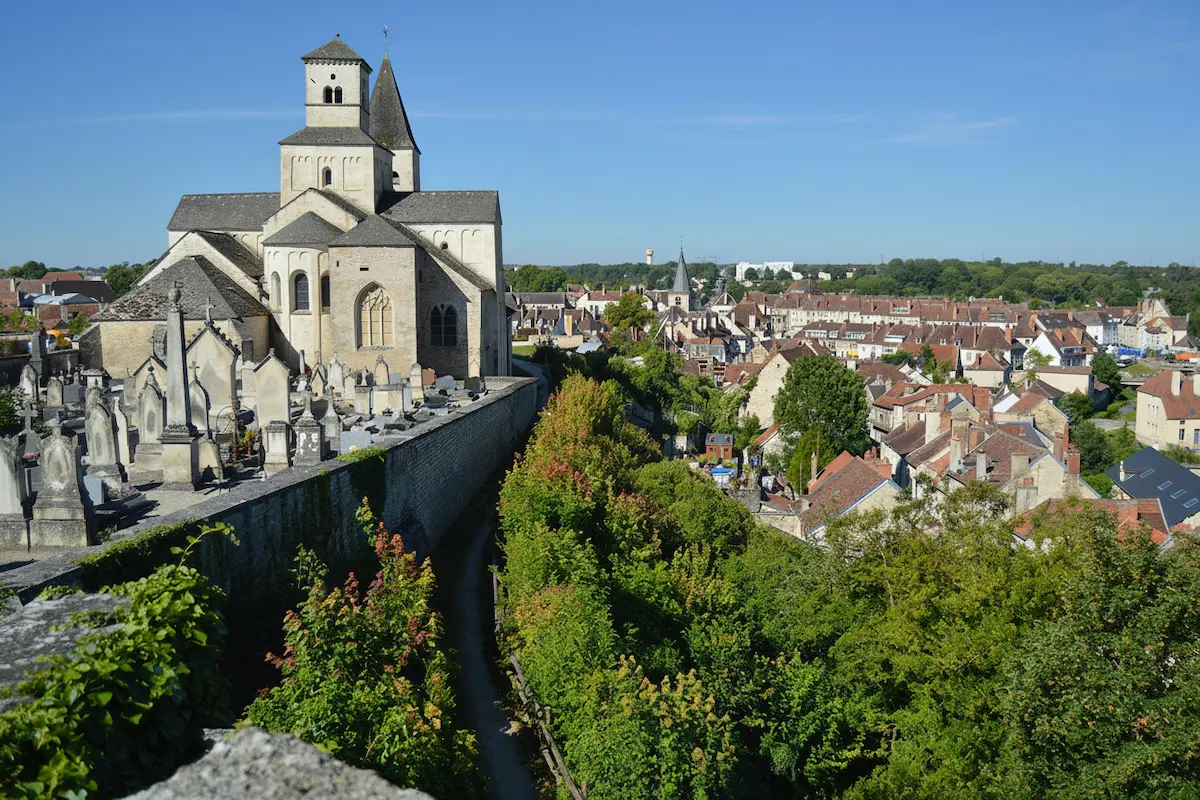


Saulieu is first a story of taste and stone. Northern gateway to the Morvan Regional Nature Park, this town in the Auxois is built at the crossroads of two Roman roads. But what has made it famous far beyond Burgundy is its double heritage: a 12th-century Romanesque basilica and a gastronomic tradition carried by two of France’s greatest chefs. This guide takes you through Saulieu, its monuments and its table.
The Saint-Andoche Basilica: a masterpiece of Romanesque art
A papal consecration
The Saint-Andoche Basilica is the jewel of Saulieu. Consecrated in 1119 by Pope Calixtus II in person, it is a pure example of Cluniac Romanesque architecture. Its massive silhouette, with its square bell tower and apse with radiating chapels, dominates the town’s central square.
The interior impresses with its harmonious proportions: a nave vaulted with a barrel vault, side aisles and a projecting transept. But the true treasure of Saint-Andoche lies in its historiated capitals. These Romanesque sculptures, carved around 1130-1140, depict striking biblical scenes.
The Charlemagne Gospel Book
The basilica preserves a priceless treasure: the Gospel book known as Charlemagne’s, a 9th-century manuscript whose Byzantine ivory binding - dated to the late 6th or early 7th century - is one of the oldest in Europe. The original is kept at the François Pompon Museum; a copy made by the Louvre workshops is displayed in the basilica.
Saulieu: a legendary gastronomic town
Dumaine and Loiseau: two giants of French cuisine
It all began with Alexandre Dumaine, who earned three Michelin stars as early as 1935 at the Hôtel de la Côte d’Or. In 1975, Bernard Loiseau, a 24-year-old Burgundian chef, took over the establishment. His light “water-based cuisine” shook up the codes of French gastronomy. He obtained his third star in 1991. His iconic dishes - Morvan ham with cream, eggs meurette, crushed potatoes - became famous worldwide.
On 24 February 2003, Bernard Loiseau’s death by suicide shook the gastronomic world. Chef Patrick Bertron, his second-in-command for twenty years, took over the stoves and has maintained two Michelin stars at the Relais Bernard Loiseau, today a member of Relais & Châteaux.
Tip: The Saturday morning market is one of the most renowned in the region. The Charolais Festival in August celebrates the local Charolais beef.
The François Pompon Museum and his Bull
François Pompon (1855-1933) was born in Saulieu. After working as a practitioner for Rodin and other Parisian sculptors, he found his own style after 60: radical simplification of forms, perfect smoothness giving his animals an almost living presence.
The museum dedicated to him, housed in the former abbey palace, presents the largest collection of his works: polar bear, stag, doe, panther, rooster, owl and many more. Each sculpture carries the Pompon signature.
The Bull, symbol of Saulieu
Pompon’s most famous work, the Bull, has become the town’s emblematic monument: a monumental bronze, the “Monument to Pompon”, inaugurated in 1949 on the Market Square as a tribute to the sculptor.
Walking around Saulieu
Saulieu can be explored on foot in an hour. The historic centre is compact: from the basilica square, go down Rue de l’Hôtel-de-Ville to the Market Square, the town’s living heart. To the south, the Morvan Regional Nature Park begins: Lake Settons (25 km), Mount Beuvray (40 km), and the Haut-Folin, the highest point of the Morvan at 901 m (35 km).
Practical information
Getting there
By car or train
- By car: A6 exit 24 (Pouilly-en-Auxois) or 23 (Bierre-lès-Semur), follow the D980.
- By train: Montbard TGV station (Paris-Montbard in 1h), then taxi (35 min).
When to come
May for the Grand Morvan Gourmet Days, August for the Charolais Festival.
Frequently asked questions
How long does it take to visit Saulieu?
When is the best time to visit Saulieu?
Can I visit Saint-Andoche basilica freely?
What part of the Morvan can I see from Saulieu?
Another question?
Write to usSources