
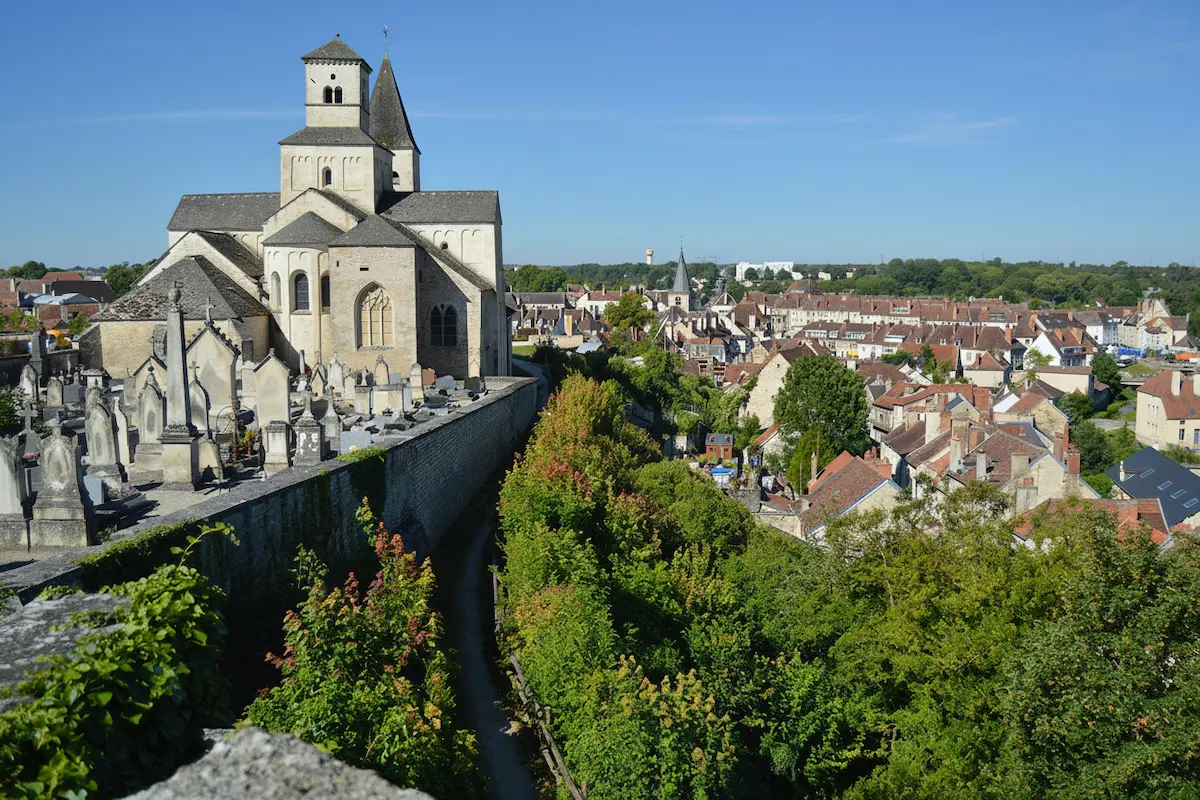


In short: Côte-d’Or is a photographer’s paradise, from Dijon’s glazed roofs to Beaune’s terraced vines and Auxois hilltop villages. The best light is at sunrise (5.40–6.30am in summer) and before sunset (6pm–8.30pm). Viewpoints on the Route des Grands Crus are the most accessible spots.
Whether you are a smartphone amateur or an enthusiast with a DSLR, Côte-d’Or offers a surprising variety of landscapes for a département of 8,763 km². From Dijon’s glazed tile roofs to Morvan lakes and terraced vineyards, here are the best spots for photos that stand out.
Dijon: architecture on every corner
Place de la Libération
Place de la Libération, details
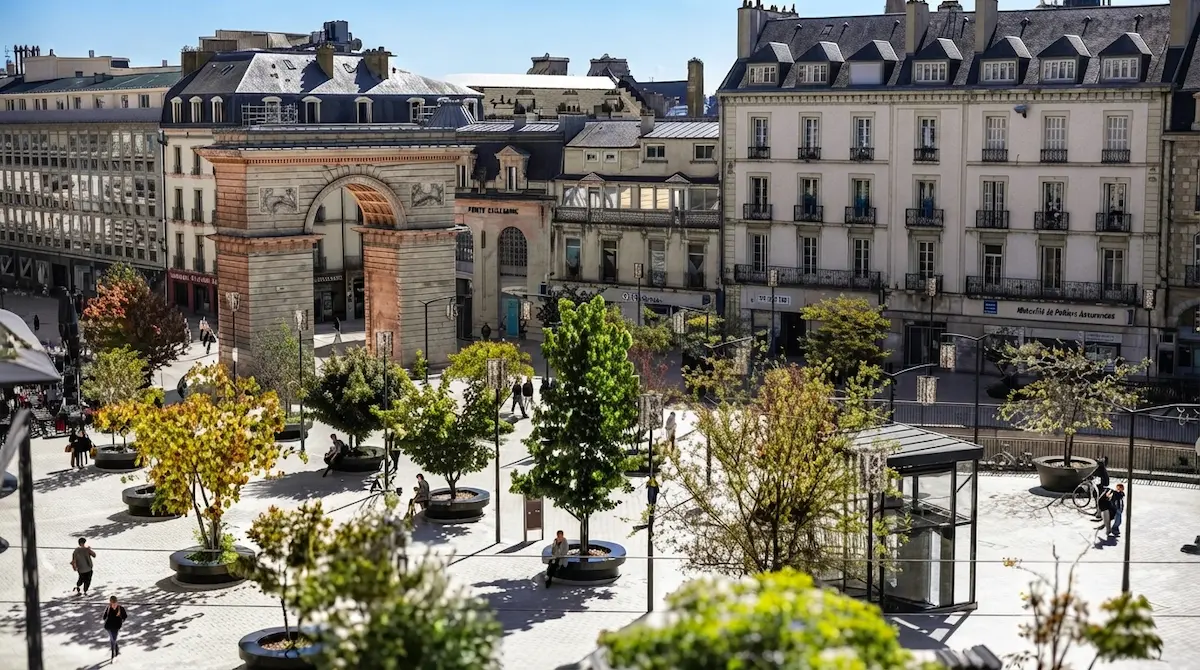
The semi-circular square designed by Jules Hardouin-Mansart is an infinite photographic playground. Best moment: just after a shower, when cobbles reflect golden light. Photograph the square from the end of rue de la Liberté for perfect symmetrical perspective. At sunset, façades take a warm tone and street lamps switch on, creating striking contrast.
City roofs from Tour Philippe le Bon
Tour Philippe le Bon (316 steps) offers Dijon’s most emblematic view. At 46 metres, you take in polychrome glazed tile roofs, church spires and, on clear days, vineyard hills as far as Beaune. Rates and reservation obligatory at the tourist office, on destinationdijon.com (guided tour of 45 min, in small groups). The most spectacular shots are taken mid-morning, when sun lights the roofs without harsh shadows. A 70–200 mm telephoto isolates the geometric patterns of the tiles.
The Owl Trail, street-photo version
The 22 stages of the Owl Trail offer a series of perfect frames: the Gothic façade of Notre-Dame church (with its 51 gargoyles), the town hall courtyard (former ducal palace), rue des Forges (15th-century half-timbered houses), and 17th-century town houses on rue de la Chouette. The trail is also an excellent street-photography school: during market time, alleys come alive.
Jardin Darcy and its fountain
Jardin Darcy, place Darcy, offers a view of the bear fountain and the tram entrance. The fountain is especially photogenic in spring (flowering planters) and autumn (orange tree tones). In winter, frost on the stone bears makes for original shots.
Beaune: the medieval jewel
Hospices roofscape
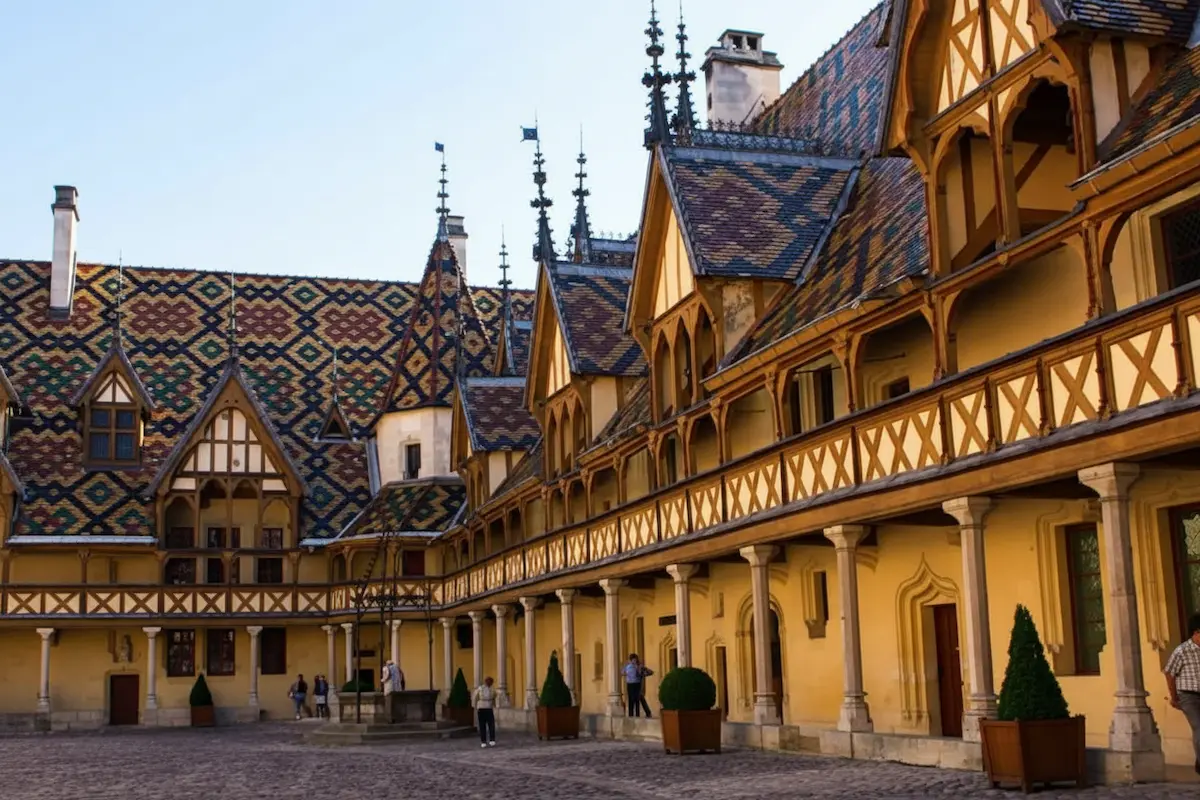
Burgundy’s most Instagrammed shot is the bird’s-eye view of Hospices de Beaune glazed tile roofs, recognisable from the parvis (forecourt) and the adjacent streets. Green, red, yellow and brown tiles form geometric patterns reminiscent of Burgundy roofs.
South-west ramparts
The walk along the south-west ramparts (from porte Saint-Nicolas, the only surviving gate) offers views over Beaune roofs, surrounding vines and, in the distance, the Côte de Beaune hills. Ideal light late afternoon, when low sun emphasises relief.
Rue de l’Enfer
This steep medieval street, lined with 15th- and 16th-century houses with glazed tile roofs, is one of Beaune’s most photographed. The angle from the bottom of the street (looking up) creates a spectacular perspective effect. Go early morning, before tourists arrive.
Character villages
Flavigny-sur-Ozerain
- GPS
- 47.5119, 4.5306 (roadside belvedere, lower car park)
- Best time
- Late afternoon, raking light on the rocky spur
- Tip
- From the roadside belvedere, include the Ozerain valley below; in July-August, the sunflowers in the foreground. A 24-70 mm is enough.
Semur-en-Auxois
- GPS
- 47.4892, 4.3341 (pont Joly)
- Best time
- Sunset, golden limestone
- Tip
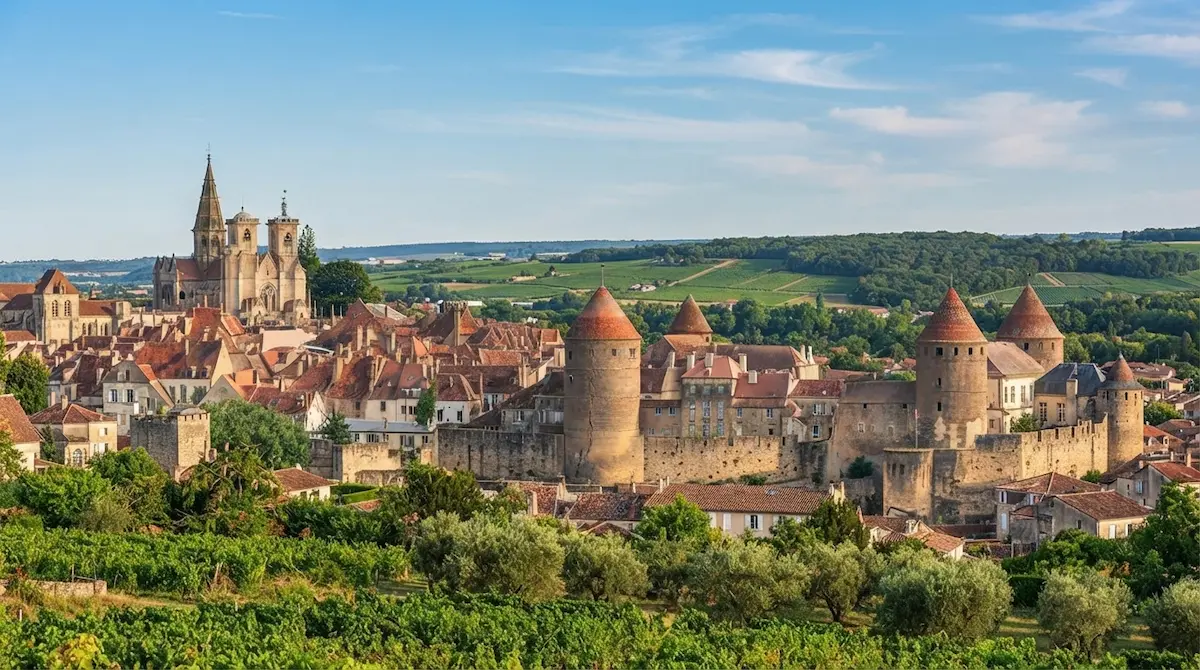
- Frame the towers with their reflection in the Armançon from pont Joly; get there 20 minutes before sunset.
Châteauneuf-en-Auxois
- GPS
- 47.2172, 4.6422 (castle)
- Best time
- Morning; in April-May, rapeseed in flower in the foreground
- Tip
- From the D977bis to the south, a telephoto (70-200 mm) tightens the castle and flattens the perspective over the plain.
Vineyards: the finest panoramas
Route des Grands Crus (D974)
The departmental road along the Côte de Nuits and Côte de Beaune is France’s finest wine axis, and the easiest to reach: viewpoints follow one another as you pass the villages. The three belvederes below are the most reputed.
- GPS
- 47.2212, 4.9636 (car park above the Clos de Bèze)
- Best time
- Sunrise, morning mists in the combe
- Tip
- 100 m of walking from the car park (sentier du Tacot) to reach the belvedere. Free access from the D974.
- GPS
- 47.1595, 4.9535 (Vosne cemetery car park)
- Best time
- Late afternoon, grands crus in golden light
- Tip
- 10 to 15 min climb from the cemetery; a 70-200 mm isolates each parcel and its name boards.
- GPS
- 46.9306, 4.6722 (Trois Croix summit)
- Best time
- Sunset, facing the Saône and the Jura
- Tip
- Park at Louchardes (route de Nolay): 10 min on foot to the summit. Classified natural area: do not leave the paths.
The arrière-côte
Less busy than the D974, the arrière-côte wine route (Pernand-Vergelesses, Savigny-lès-Beaune) offers wilder landscapes, with steep-slope vines and forest on the ridge.
- GPS
- 47.0800, 4.8515 (place de la Gare car park, Pernand-Vergelesses)
- Best time
- Dawn, mists over Beaune
- Tip
- Circuit of 6 km (2 h, 190 m of elevation gain); the belvedere is 300 m after the start, on the stony path along the hillside.
Lesser-known spots
Away from the busiest circuits, two sites are worth the detour for original photos, far from the crowd.
La butte de Vergy (Reulle-Vergy)
- GPS
- 47.1772, 4.8876 (castle ruins)
- Best time
- Late afternoon, raking light on the vines
- Tip
- Park at Reulle-Vergy church, then a 20-25 min climb; allow good shoes, the ground is uneven.
Château de La Rochepot
- GPS
- 46.9565, 4.7466 (castle)
- Best time
- Afternoon, sun lighting the roofs head-on
- Tip
- The best shot is from the D973 west of the village; in autumn, the foreground vines turn red and gold.
Nature and lakes
Lac des Settons (Morvan)
The Morvan’s largest lake (366 hectares, 586 m above sea level) offers postcard landscapes. Ideal photo spot: from the beach of the presqu’île des Settons (Pavillon Bleu label), with the 19th-century granite dam in the background. In autumn, Morvan forest colours reflect in the water. Sunrise, between 6am and 7am depending on season, offers magnificent morning mist. GPS: 47.180, 4.050.
Burgundy Canal
Locks, tree-lined banks and barges make the Burgundy Canal a timeless photo subject. Finest sections:
- Pouilly-en-Auxois: a flight of 7 successive locks (n° 1Y to 7Y) rising just before the Pouilly tunnel, the canal’s highest point (GPS 47.2610, 4.5580).
- Pont d’Ouche: picturesque port, barges and waterside café (GPS 47.2375, 4.6795).
- Tanlay (Yonne, 30 min from Montbard): canal bordered by century-old plane trees.
Châtillon-sur-Seine forest
The sources of the Seine, a listed site, offer poetic natural frames: the cave where the Seine rises and the nymph statue. Light is best early morning to avoid tree shadows. Free access. GPS: 47.4890, 4.7278.
Tips for vineyard photography
- Golden hour: vines are most photogenic 1 hour after sunrise and 1 hour before sunset. At midday, vertical sun flattens relief.
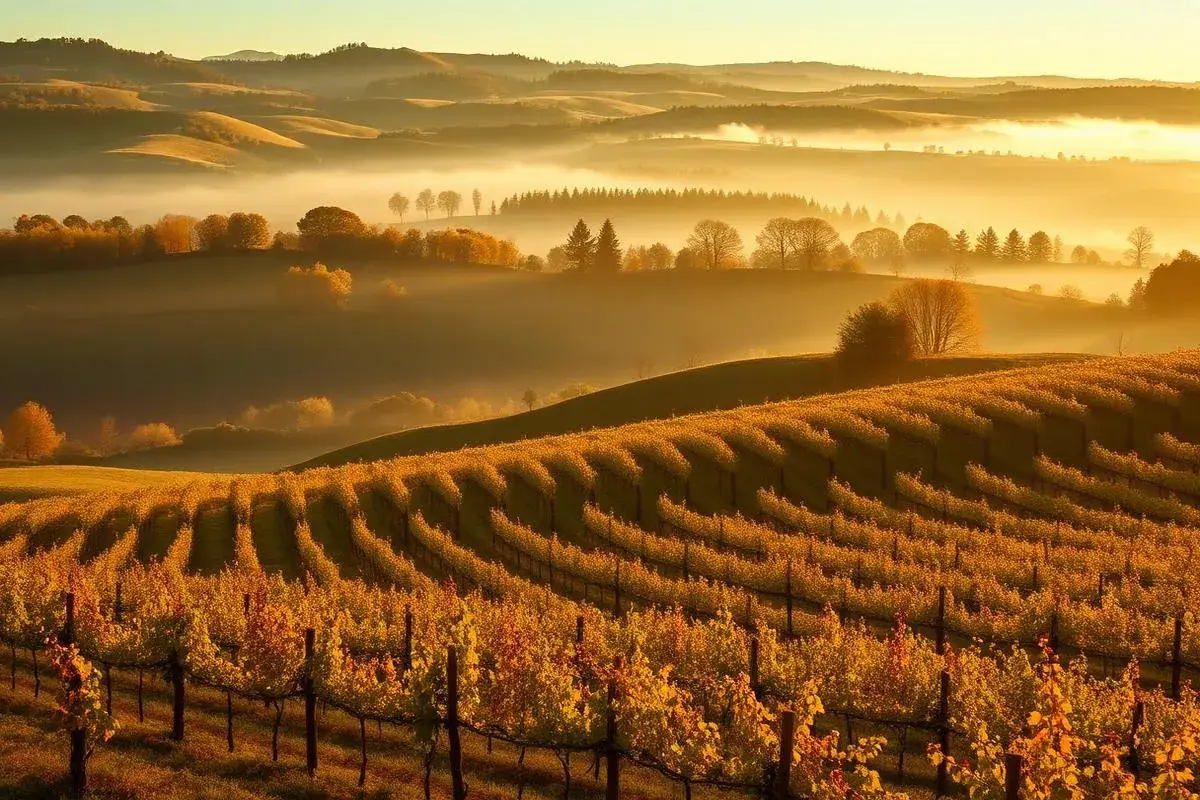
- Seasons: May–June (flowering vines, vivid green), September (véraison, coloured grapes), October (harvest, orange leaves), November (bare vines, mist).
- Polarising filter: essential for vines, it reduces leaf glare and saturates colours. Deep blue sky with green vines is the signature of the finest Burgundy photos.
- Drone: permitted in the vineyard with prior declaration (uninhabited zone, no overflight of wine estates). Forbidden in UNESCO vineyard zones without special authorisation. Check with the prefecture.
- People: winemakers at work in the vines make excellent subjects, but always ask permission before photographing them. A smile and a few words are enough. In October, harvest workers are easier to approach.
Smartphone photography: 7 habits that change everything
- Clean the lens: a wipe with a microfibre cloth (or a T-shirt) improves more photos than any setting.
- Enable the grid (rule of thirds) and look for leading lines: vine rows, medieval alleys, canal banks.
- Lock the exposure: tap the screen on the bright area (the sky) so the glazed tiles do not burn out, then adjust the brightness.
- Enable HDR for high-contrast scenes: sky + vines, sunny alleys.
- Portrait mode to isolate a detail: a grape bunch, a gate, a cellar sign.
- Avoid digital zoom: use your feet or crop afterwards, smartphones often crop better than their zoom.
- Edit lightly: Lightroom Mobile or Snapseed (free) are enough: contrast, warmth, cropping. Avoid over-saturated filters, which drown Burgundy colours.
Respecting people and privacy
- Ask before photographing: winemakers at work, shopkeepers, and above all children. A smile and “may I take your photo?” almost always work, and if someone refuses, delete the photo.
- Stay on public paths: vineyard paths, belvederes, open roads. Do not enter private plots, even for an “in the middle of the vines” shot.
- Drones: mandatory online declaration, no overflight of houses, private gardens or groups of people, regulated height and distance. In the UNESCO-listed vineyard, check with the prefecture.
- Be discreet about geolocation: do not reveal the exact location of private property or of a photographed person without their consent.
- No photos during religious services or private moments; respect requests to remove photos on social media.
The seasons in images
| Season | Dominant colours | Recommended spots |
|---|---|---|
| Spring (March–May) | Tender green, yellow rapeseed, white blossom | Rapeseed fields around Châteauneuf and the Aloxe plateau (April-May), Flavigny, Côte de Beaune, canal |
| Summer (June–August) | Deep green, blue sky, sunflower fields | Flowering vines (June) on the Côte, Morvan and lakes, sunflowers at the foot of Flavigny |
| Autumn (Sept–Nov) | Orange, red, gold, morning mist | Harvest on the Route des Grands Crus (Sept.-Oct.), Hospices roofs between the yellow leaves, Morvan forests |
| Winter (Dec–Feb) | Grey, white (frost), limestone | Dijon and Beaune roofs (midday, after the frost), bare vines, sources of the Seine |
Autumn is the most photogenic season for vineyards: the harvest (September-October) brings colour and life to the Route des Grands Crus. Spring is ideal for Dijon’s parks and gardens and the rapeseed fields; summer light on Dijon’s roofs is no less striking.
Golden hours, season by season
Indicative solar times for Dijon (latitude 47.3°), allow ±10 minutes depending on location and relief (the east of the département is ahead, enclosed valleys behind).
| Period | Sunrise | Morning golden hour | Evening golden hour | Sunset |
|---|---|---|---|---|
| 21 June | 5.40 a.m. | 6–7.30 a.m. | 8.30–9.45 p.m. | 9.40 p.m. |
| 21 March | 6.45 a.m. | 7.30–8.45 a.m. | 5.45–7 p.m. | 6.55 p.m. |
| 21 September | 7.25 a.m. | 8.10–9.20 a.m. | 6.30–7.35 p.m. | 7.35 p.m. |
| 21 December | 8.25 a.m. | 9–10.15 a.m. | 3.30–4.30 p.m. | 4.45 p.m. |
In winter the days are short, but the frost light on Dijon’s roofs and bare vines is worth the early start: the 9–10.15 a.m. window is the most reliable for a clear sky.
Frequently asked questions
Can I photograph cellars and vats at wine estates?
What is the best time to photograph Hospices de Beaune without tourists?
Do I need a filming permit to photograph in the UNESCO vineyard?
Another question?
Write to usSources
- Côte-d'Or Tourisme: Viewpoints
- Dijon Métropole Tourisme: Best spots
- Beaune Tourisme: Photo and video
- Morvan Regional Natural Park: Photography
- Météo France: Dijon sunrise/sunset times
- Saône riverbanks: Côte-d'Or
- Ville de Beaune: Gardens and green spaces
- Wikipedia: Climats of the Burgundy vineyard
- Côte-d'Or Tourisme: Character villages