


In brief: founded in 1443 by Chancellor Nicolas Rolin and his wife Guigone de Salins, the Hospices de Beaune comprise the Flamboyant Gothic Hôtel-Dieu with its famous glazed tile roof, Rogier van der Weyden’s Last Judgment polyptych and a 60-hectare wine estate whose annual charity auction each November is the most famous in the world.
The Hospices de Beaune bring together everything that makes Burgundy’s reputation : exceptional medieval heritage, a masterpiece of 15th-century Flemish painting and a centuries-old wine tradition. The Hôtel-Dieu operated as a hospital until 1971 before becoming a museum. It now attracts about 300,000 visitors per year, making it the most visited monument in Côte-d’Or.
This page focuses on what makes the Hospices unique in France : the story of its founding, its architecture, its polyptych and its wine auction.
A charitable foundation in the heart of the 15th century
Nicolas Rolin and Guigone de Salins, the founders
In 1443, as the Hundred Years’ War was ending and plague still ravaged Burgundy, Chancellor Nicolas Rolin — right-hand man to Duke Philippe le Bon and one of the most powerful figures in the kingdom — decided with his third wife Guigone de Salins to found a hospital for the destitute. Their motives mixed Christian faith with charitable duty : Rolin, whose wealth and influence drew criticism, saw this hospital as a way to “redeem his soul.” The couple invested their personal fortune and endowed the institution with revenues ensuring its complete autonomy, independent of both the Church and the Duke.
The hospital admitted its first patient in 1452 and remained in continuous operation until 1971. For over five centuries, communities of nuns — the Dames de la Charité then the Soeurs Hospitalières — cared for the sick, elderly and orphans in the great communal hall called the Salle des Povres.
A “palace for the poor” in Flamboyant Gothic style
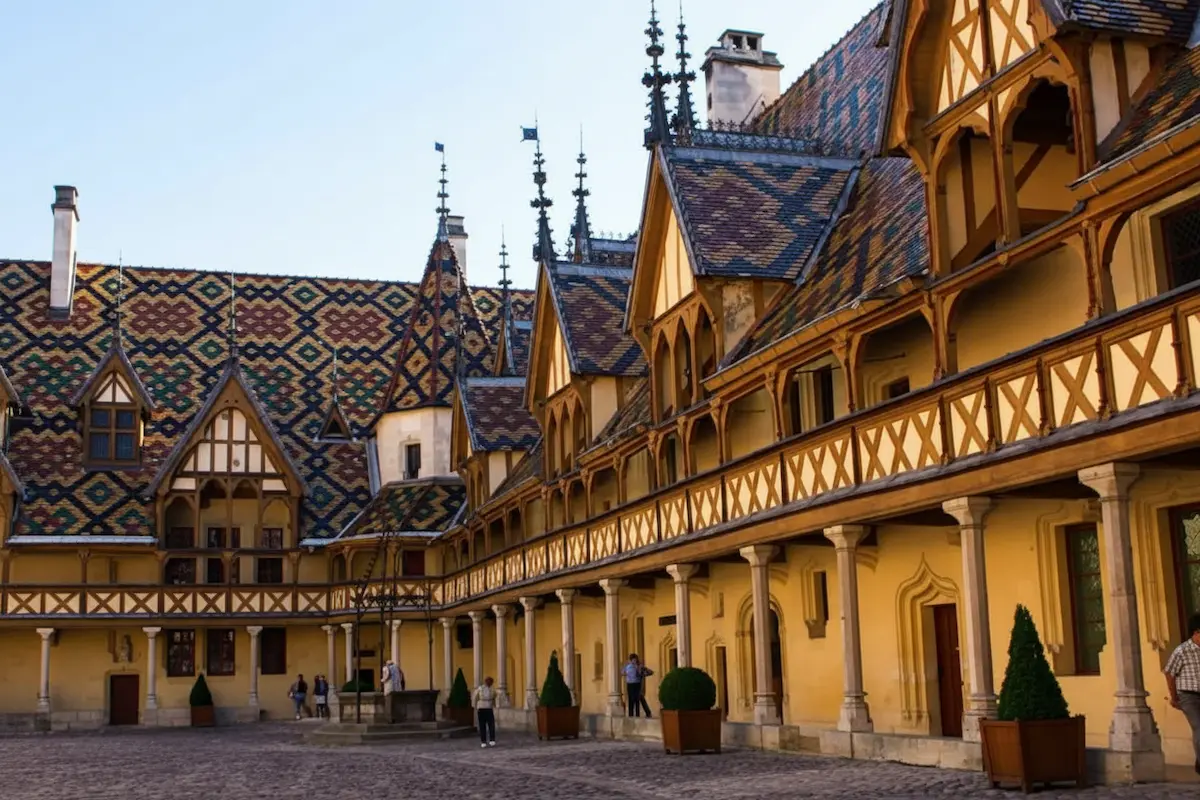
Nicolas Rolin did not want a modest building. He commissioned an edifice that would mark the territory : a hospital built as a palace, in the Flamboyant Gothic style with Flemish influence, featuring an inverted ship’s hull roof frame, coloured stained glass and ceramic tile floors. The Salle des Povres, used as a communal dormitory, measures 50 metres long by 14 metres wide and retains its original canopy beds. In contrast to the dark, narrow medieval hospice, the Hôtel-Dieu was designed to be bright, high-ceilinged and dignified — a way to restore humanity to those society had cast aside.
This architectural ambition also explains the roofing. Choosing to cover a building of this scale with glazed tiles costs 3 to 4 times more than ordinary tiles : it was a display of power and patronage as much as an aesthetic choice.
The glazed tile roof, Beaune’s emblem
The Hôtel-Dieu’s roof is the most reproduced image of Beaune, and arguably of all Burgundy’s wine country. The ceramic tiles are coated with a lead-based glaze giving them their shine and colours : yellow, green, red, brown and black. Laid in geometric patterns — lozenges, chevrons, horizontal bands — they form a polychrome checkerboard that visitors often compare to snakeskin.
The glazed tile technique has been known since Roman times, but its development in Burgundy dates from the 14th century. At the Hôtel-Dieu, slate covers the most noble parts (an innovation introduced by Philippe le Hardi), while glazed tiles decorate the secondary roofs, creating a visual hierarchy readable from the main courtyard. Even Burgundy’s most famous roofs — in Dijon (Hôtel de Vogüé, Palais des Ducs) — do not rival the visual impact of those of the Hospices de Beaune.
The Last Judgment polyptych by Rogier van der Weyden
A masterpiece commissioned for the chapel
Commissioned in 1443 by Nicolas Rolin and Guigone de Salins for the Hôtel-Dieu chapel, the Last Judgment polyptych — also known as the Beaune Altarpiece — is considered one of the major works of 15th-century Flemish painting. It is painted in oil on nine oak panels, six of which are painted on both sides, for a total of 15 paintings. When open, it measures 5.48 m wide by 2.20 m high.
The outer panels are hinged : closed on weekdays to protect the work from light and view, they were opened only on Sundays and feast days, revealing the full vision of the Last Judgment to the assembled faithful.
Composition and meaning
At the centre of the main panel, Christ sits on a rainbow, haloed in light, his feet resting on a golden globe. His right hand blesses while his left points to the damned. Below, the Archangel Saint Michael weighs souls with a scale : evil weighs heavier than good, dragging the damned to hell. In the upper register, the Virgin Mary and Saint John the Baptist intercede on either side of Christ, surrounded by apostles and saints. In the lower register, souls emerge from the earth — the elect move toward a golden palace (Paradise, to Christ’s right) while the damned fall into a flaming abyss (Hell, to his left).
A recent discovery by the Factum Foundation in 2023 using 3D scanning revealed that van der Weyden had modified the position of the scale pans during creation : originally, the souls of the elect weighed more (symbolizing their spiritual weight), but the painter reversed the composition so that evil ultimately prevails — a strong theological choice emphasising divine mercy rather than the certainty of salvation.
Conservation and restoration
The work has suffered over the centuries : paint loss, darkening, dirt accumulation. A major restoration between 1875 and 1878 involved sawing the six double-sided panels in half to display them separately, and a thick layer of overpaint was applied. Today, the polyptych has been moved from its original location to protect it from light and the 300,000 annual visitors.
The Hospices de Beaune wine auction
From the first donation to a global event
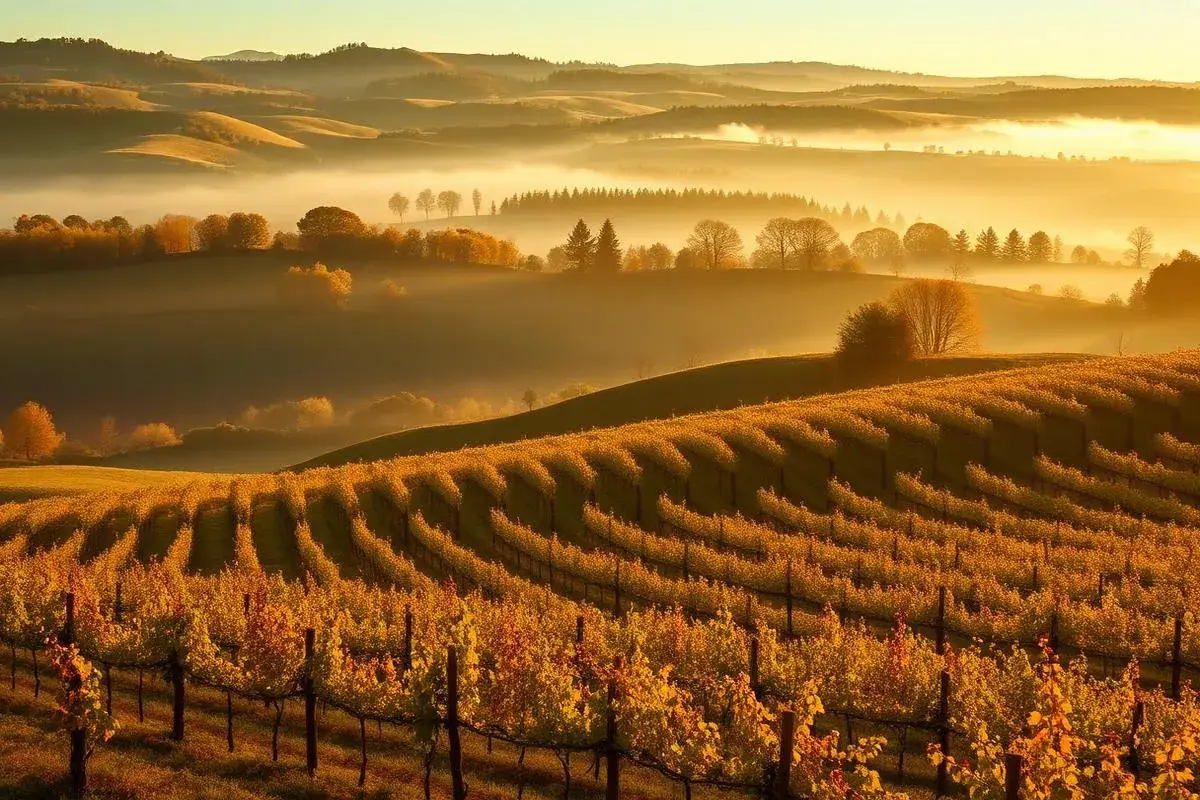
The first vineyard donation to the Hôtel-Dieu dates to 1457, when Jean Guillotte le Verrier bequeathed a plot called “Beaumont Le Franc.” This gesture began a tradition of gifts and legacies that has continued to the present day and built the Domaine des Hospices de Beaune, now 60 hectares with 85% classified as Premier or Grand Cru. The estate produces about 50 cuvées each year, including 33 reds (pinot noir) and 18 whites (chardonnay), spread across the Côte de Beaune and Côte de Nuits.
The auction was created in 1859 by the Hospices administration to maximise revenue from the estate and fund the hospital. It takes place every third Sunday of November, closing the Trois Glorieuses of Burgundy : Saturday, the Confrérie des Chevaliers du Tastevin Chapter at Clos de Vougeot ; Sunday, the Hospices auction ; Monday, the Paulée de Meursault.
Figures and evolution
The sale has become the largest charity wine auction in the world. Turnover has grown spectacularly, culminating at 28.91 M euros in 2022 (all-time record). Since 2005, the auction has been handled by an international auctioneer and pieces can be bought individually. The “candle auction” system now only survives for the Pièce des Présidents, a charity lot sold each year at an exceptional price (360 000 euros in 2024).
Since 2009, individuals can bid online from a single bottle. Since the 2024 vintage, the estate is certified organic at cellar exit.
Visiting the Hôtel-Dieu today
The Salle des Povres and the visitor route
The self-guided tour “Sur les pas des fondateurs” (In the founders’ footsteps) begins in the Salle des Povres, the historic heart of the Hôtel-Dieu. This vast hall, 50 metres by 14, retains its inverted ship’s hull roof frame, period tapestries and canopy beds (the “quilles”) where the sick slept, sometimes several to a bed. The tour continues to the apothecary, rich with hundreds of faience pots and 18th-century woodwork, the kitchen with its monumental fireplaces and the chapel where van der Weyden’s polyptych is displayed.
A behind-the-scenes tour provides access to areas usually closed to the public : the upper gallery of the main courtyard, the King’s Chamber, the old wine vat room and the medieval bastion.
Opening hours and prices 2026
| Period | Hours |
|---|---|
| 1 April to 15 November | 9:00 am to 7:30 pm (continuous) |
| 16 November to 31 March | 9:00 am to 12:30 pm and 2:00 pm to 6:30 pm |
Closed : 1 January and 25 December (afternoon only 2 pm to 6:30 pm). Last entry : 1 hour before closing.
Prices 2026 : full price 12.50 euros (with audioguide), reduced price 9.50 euros (students under 26, large families, unemployed), youth 6.25 euros (6-17), free for under 6. The behind-the-scenes tour is 14.50 euros.
Frequently asked questions
When is the best time to visit the Hôtel-Dieu?
Can I buy Hospices de Beaune wine on site?
How long does the Hôtel-Dieu visit take?
Is the Hôtel-Dieu accessible to people with reduced mobility?
Another question?
Write to usSources
- Hospices de Beaune - Official history
- Hospices de Beaune - Auction history and purpose
- Hospices de Beaune - Wine estate
- France.fr - Hospices de Beaune
- Decanter - What is the Hospices de Beaune?
- Wikipedia - Beaune Altarpiece (polyptych)
- Factum Foundation - Beaune Altarpiece 3D scan
- Petit Futé - Visiting the Hospices de Beaune
- Bourgogne Tourisme - Hôtel-Dieu de Beaune
- Côte-d'Or Tourisme - Beaune