
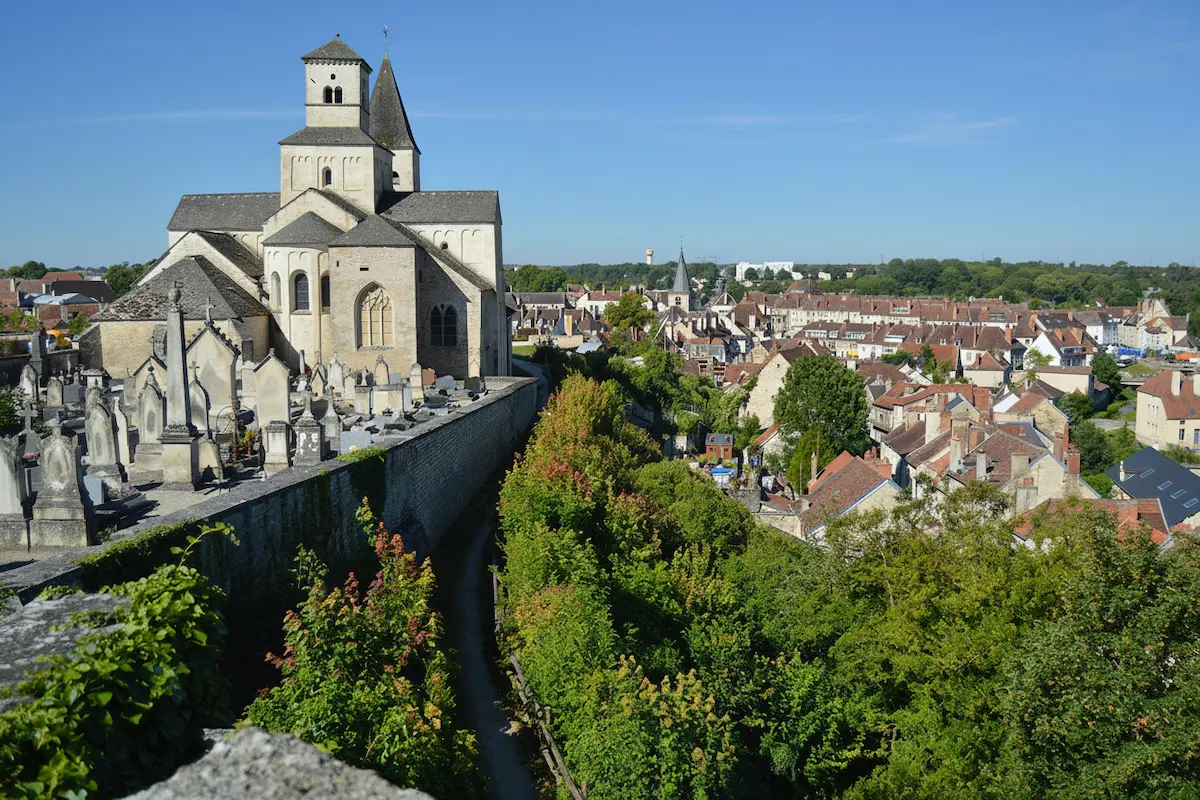


In short: the Canal de Bourgogne crosses Côte-d’Or for 110 kilometres, from the border with the Yonne (north of Montbard) to Saint-Jean-de-Losne, offering two complementary experiences: the greenway for cyclists (EuroVelo 6, flat and safe) and self-drive boating for lovers of slow travel. With its locks, aqueducts, 3,333-metre tunnel and landscapes of vineyards and bocage, the canal is one of the finest ways to discover Côte-d’Or at the pace of the water.
The Canal de Bourgogne is more than a waterway. It is a promenade, a tourist route, a thread that runs through the most varied landscapes of Côte-d’Or: the vineyard slopes of the Côte de Nuits, the green valleys of the Auxois, the plateaux of the Châtillonnais, the bocage of the Morvan. Whether you travel it by bike, on foot or by boat, it offers a calm, continuous reading of the territory, away from road noise.
History of the Canal de Bourgogne
A monumental project
Construction of the Canal de Bourgogne was decided in the 18th century to meet a strategic need: linking the Seine basin (and thus Paris and the Atlantic) to the Rhône basin (and thus the Mediterranean), without going via the Strait of Gibraltar. The project was approved by royal edict in 1773, under Louis XVI, but work was interrupted by the French Revolution and only truly resumed at the start of the 19th century.
The undertaking was vast: 242 kilometres of canal to dig, 189 locks to build, a 3,333-metre tunnel to bore under the Pouilly-en-Auxois watershed (the longest canal tunnel in France), and aqueducts to carry the canal across valleys. Up to 8,000 workers laboured on the site at once. The canal was finally opened in 1832.
Decline, then a tourist revival
For more than a century the canal was an important commercial artery, carrying Burgundy wine, Morvan timber, dressed stone, coal and grain. But competition from the railway (from the late 19th century) and then road haulage (in the 20th) eroded freight traffic. Commercial traffic stopped altogether in the 1970s.
Since then the canal has undergone a remarkable tourist reconversion. The greenway along its banks has become one of France’s busiest cycle routes, part of the EuroVelo 6 network (the Rivers Route from the Atlantic to the Black Sea). Self-drive boat hire has grown, with a main base at Saint-Jean-de-Losne.
The Canal de Bourgogne by bike
The greenway: flat and safe
Almost the entire Canal de Bourgogne is edged by a wide, flat, stabilised towpath, ideal for cycling. Once used to haul barges by hand or horse, it is now a greenway reserved for walkers, cyclists and sometimes riders. The surface is mainly compacted gravel or tarmac, suitable for most bikes (hybrid, mountain bike, road bike with wider tyres, e-bike).
The Canal de Bourgogne greenway forms part of EuroVelo 6 (EV6), the rivers route across Europe from Nantes to Constanța (Romania). It is one of France’s best-signed cycle routes, with regular waymarkers, rest areas, water points and services (bike hire, restaurants, lodging) at steady intervals.
Sections in Côte-d’Or
In Côte-d’Or the canal greenway splits into several sections, all rideable in both directions:
Pont-de-Pany to Dijon (20 km): the stretch most loved by Dijon residents. The most picturesque part runs from Dijon (canal port, near the station) to Velars-sur-Ouche, where the Ouche valley narrows and cliffs overlook the canal. Locks come in quick succession, giving a pleasant rhythm to the ride. At Pont-de-Pany the valley widens and opens a fine view over wooded slopes.
Dijon to Saint-Jean-de-Losne (35 km): after Dijon the canal turns south from the Burgonde junction. The landscape opens onto the Saône plain, with cereal and rape fields. Saint-Jean-de-Losne, “France’s first river town”, is the junction of the Canal de Bourgogne and the Saône, with an impressive marina.
Pont-de-Pany to Pouilly-en-Auxois (35 km): the most spectacular section, which climbs the watershed via the Pouilly-en-Auxois flight, where the locks follow one another up to the summit (378 metres). The landscape becomes rolling, forests replace meadows, and the canal winds between the Auxois hills. The villages along the way (Sainte-Marie-sur-Ouche, Gissey-sur-Ouche, Créancey) are charming.
Recommended routes
- Family outing (1h–2h): Dijon (canal port)–Velars-sur-Ouche (10 km one way). Flat, partly shaded, with several picnic spots. Suitable for children on bikes.
- Half-day (3–4h): Dijon–Pont-de-Pany (20 km one way). Option to continue to the Pont-de-Pany viaduct for more distance.
- Full day (6–8h): Dijon–Saint-Jean-de-Losne, return by train (35 km one way). The TER links Saint-Jean-de-Losne to Dijon with bikes allowed.
- Sporting (2–3 days): Dijon–Pouilly-en-Auxois with an overnight stop at Pont-d’Ouche or Créancey. Climbing the Pouilly flight is a moderate challenge, with about 100 metres of cumulative climb over 20 km.
Bike hire
Several outlets offer standard bikes, hybrids, e-bikes and children’s bikes:
- Dijon: several city-centre shops and hire points near the station
- Saint-Jean-de-Losne: several hire points at the marina
Rates vary by bike type (standard or e-bike) and hire duration.
The Canal de Bourgogne by boat
Self-drive hire: slow travel
Hiring a self-drive boat on the Canal de Bourgogne is a distinctive experience: you cruise at 6 km/h (the maximum allowed), work the locks by hand (each lock-keeper opens and closes the gates manually or electrically), and moor along the banks for a picnic or overnight. The pace is slow, deliberately so: that is the point.
No licence is required. The boats are designed for beginners: a 30-minute to 1-hour briefing is given by the hire base before departure. You learn the basics of inland navigation: manoeuvring, mooring, locking through. The low speed presents no danger, and lock-keepers along the route are there to guide you.
Hire bases in Côte-d’Or
Saint-Jean-de-Losne is the main hire base on the Canal de Bourgogne, and one of France’s largest inland marinas. Several hire companies are based there, including Locaboat and Nicols, now grouped under the Riverly brand. They offer boats for 2 to 12 berths, with kitchenette, bathroom and toilet.
Dijon: the canal port, near the station, welcomes moored barges; hire bases are concentrated in Saint-Jean-de-Losne.
Recommended boat routes
- Weekend (2–3 days): Dijon–Saint-Jean-de-Losne return (70 km). Easy, flat route with stops in the Ouche valley villages.
- Short week (5–7 days): Dijon–Pouilly-en-Auxois return. Climbing the Pouilly flight is one of France’s finest inland routes, with successive locks and the Pouilly tunnel.
- Long cruise (8–15 days): Dijon to the Saône (Saint-Jean-de-Losne), then south towards southern Burgundy (Chalon-sur-Saône, Tournus) or down towards Lyon.
Working the locks
One of the most memorable parts of navigating the Canal de Bourgogne is going through the locks. Each lock is a small adventure: you announce yourself with a horn, enter the chamber, make fast to the bollards, watch the water rise or fall in a few minutes, then set off again. The Pouilly-en-Auxois flight, which climbs the watershed, is one of the canal’s most spectacular stretches: the locks follow one another at a steady rhythm, and the experience is unforgettable.
Hire rates
Self-drive hire varies by season, boat size and duration: ask the hire bases for a quote, as they publish their rates per period.
The price usually includes the boat, briefing, safety equipment and fuel (consumption is low at 6 km/h). Bedding, end-of-stay cleaning and lock dues may be extra.
Curiosities along the canal
Several notable sites mark the Canal de Bourgogne route in Côte-d’Or:
- The Pouilly-en-Auxois tunnel: 3,333 metres long, France’s longest canal tunnel. The crossing takes about 30 minutes, in near-total darkness (apart from the boat’s lights). An impressive experience.
- The Pont-d’Ouche aqueduct: a structure that carries the canal across the Ouche valley, with a spectacular view of the valley.
- Saint-Jean-de-Losne harbour: one of France’s most important inland marinas, with hundreds of boats moored. The village lives by the water, with several restaurants and boatmen’s bars.
- Wash-houses and lock-keepers’ cottages: all along the canal, the old lock-keepers’ houses (often in dressed stone, with a kitchen garden) have been restored and some are still lived in. They recall a time when the canal supported hundreds of families.
- Dijon’s canal port: near the station (quai Nicolas Rolin), the canal entrance in Dijon is a pleasant spot with moored barges, bars and restaurants.
Frequently asked questions
How long is the Canal de Bourgogne in Côte-d'Or?
Can you cycle the Canal de Bourgogne in a day?
Do you need a licence to hire a self-drive boat on the Canal de Bourgogne?
What is the best season for a trip on the Canal de Bourgogne?
Another question?
Write to usSources
- Voies Navigables de France - Canal de Bourgogne
- Bourgogne Tourisme - Canal de Bourgogne by bike
- Côte-d'Or Tourisme - Canal de Bourgogne
- AF3V - Canal de Bourgogne greenway
- Dijon Métropole Tourisme - A stroll on the canal
- France Bleu Bourgogne - Self-drive boats and cycling on the canal
- Le Bien Public - Cycling routes on the Canal de Bourgogne
- Wikipedia - Canal de Bourgogne