







Perched on a rocky spur at 420 metres altitude, Flavigny-sur-Ozerain is one of the gems of the Auxois region. Classified among France’s Most Beautiful Villages, it unfolds its cobbled streets, fortified gates and Carolingian abbey in a green setting where the Ozerain, Recluse and Verpant rivers meet below. This guide takes you through its thousand-year history, architectural treasures and famous aniseed sweet - France’s oldest brand still in operation.
The history of Flavigny-sur-Ozerain: a thousand-year-old abbey
The founding of Saint-Pierre Abbey (719)
Flavigny’s story begins with the foundation of the Benedictine abbey of Saint-Pierre in 719 (or 721 according to some sources) by Wideradus, a Burgundian lord. The first written mention of the village appears in this donation charter under the Latin name Flaviniacum. The abbey was placed under royal protection from the time of Pepin the Short and Charlemagne - legend has it that the emperor himself attended the consecration of the Notre-Dame chapel.
In 878, Pope John VIII consecrated seven altars in the abbey church, which was then dedicated to Saint Peter. The abbey became one of the most influential religious centres in Burgundy during the Middle Ages.
The Carolingian crypt of Sainte-Reine
Built in the 9th century to house the relics of Saint Regina (Regine), a Christian martyr beheaded at Alise around the 3rd century, the Carolingian crypt of Flavigny is a true treasure of pre-Romanesque architecture. The relics were transferred from Alise on 21-22 March 864, at the initiative of Abbot Egil, to protect them from Viking raids that were ravaging the region.
The crypt features groin vaults supported by massive pillars, typical of pre-Romanesque architecture. Long forgotten, it was cleared in the 19th century, then excavated in the 1950s. Listed as a Historic Monument since 1906, it can be visited freely and free of charge: lighting turns on automatically when visitors arrive.
The Anis de Flavigny: France’s oldest brand
A recipe born in the Middle Ages
The Anis de Flavigny are much more than a sweet: they are the oldest French brand still in operation. The original recipe, invented by the Benedictine monks of the abbey in the Middle Ages, was taken over in 1591 by the Troubat family, who have continued it for over four centuries without interruption.
The manufacturing process is simple but meticulous: each sweet is a dragée - a green aniseed (Pimpinella anisum) is coated in successive layers of flavoured sugar syrup for fifteen days in rotating copper basins. The result is a small ovoid sweet, hard on the outside and flavoured on the inside, which melts slowly in the mouth.
An unbroken tradition since 1591
Today, the manufacture continues the recipe in its workshops set in the heart of the former abbey. Visitors can freely discover the copper basins where the dragées are coated for fifteen days, and leave with the brand’s famous metal boxes, instantly recognisable and collected all over the world.
Tip: The shop offers a self-guided tour of the sugaring workshops. Entry is free and requires no booking. Bring cash, as the card terminal is not always available.
The fortified gates and Saint-Genest Church
Porte du Val and Porte du Bourg
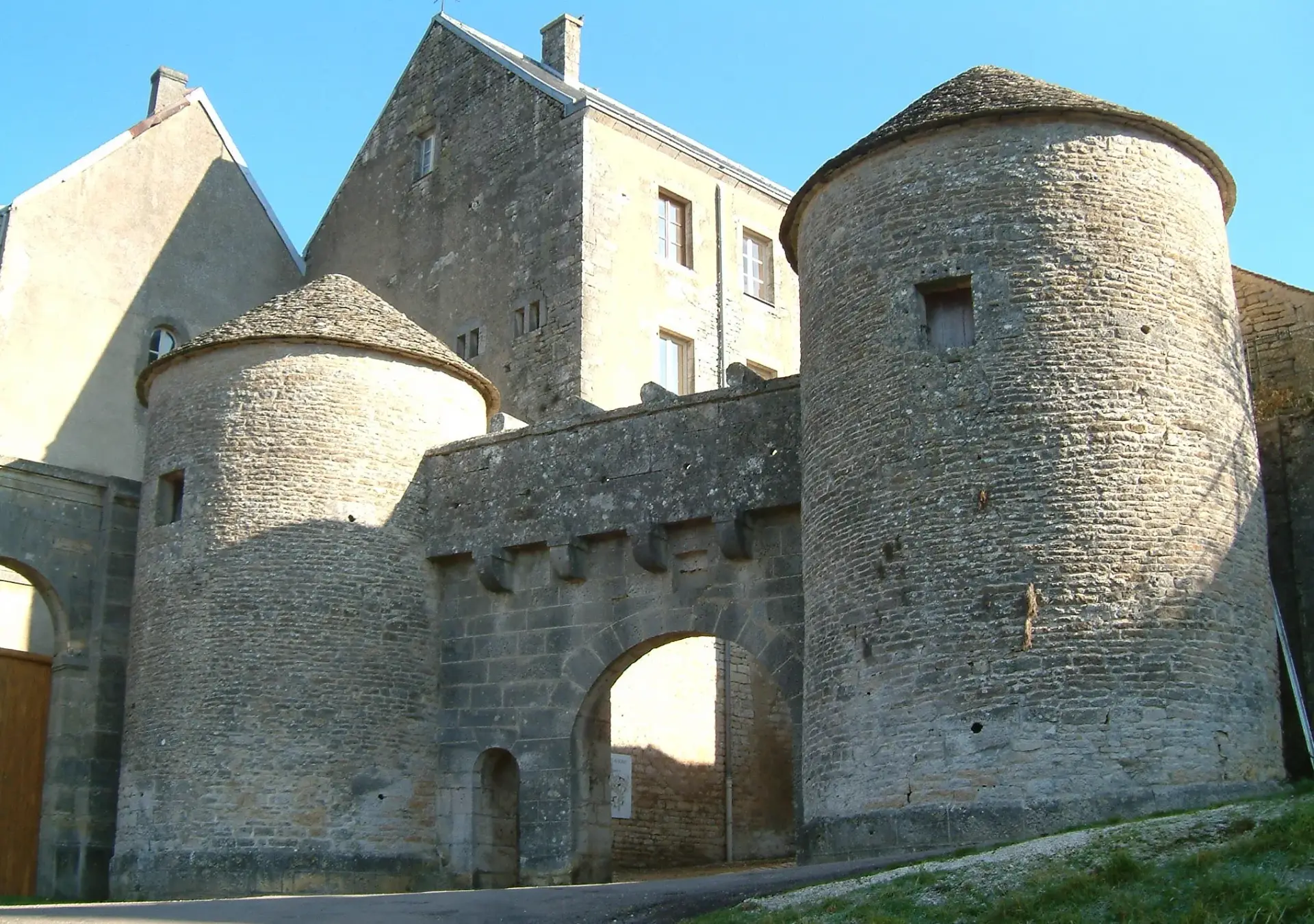
Flavigny’s strategic position on a spur made it naturally defensible. Two fortified gates remain from the medieval enclosure:
- The Porte du Val, massive, marks the village’s main entrance. Its structure and arrow slits attest to its defensive role.
- The Porte du Bourg, smaller, guarded the southern access.
Between them, cobbled streets wind between half-timbered houses and 16th and 17th-century townhouses, offering perspectives that have crossed the centuries without losing their authenticity.
Saint-Genest Church
The parish church of Saint-Genest is worth a visit for its architecture, which blends Romanesque and Gothic styles, reflecting the different construction campaigns.
The film Chocolat and Flavigny
One of the facts that has done most for the village’s international fame: the film Chocolat by Lasse Hallström (2000), starring Juliette Binoche, Judi Dench and Johnny Depp, was largely shot in Flavigny-sur-Ozerain. The church square and several streets served as the fictional Lansquenet-sous-Tannes, a village in southwestern France where an itinerant chocolatier disrupts local habits.
The filming deeply marked the village: even today, you can find chocolatiers and shops that recall this period. Film enthusiasts will recognise the Porte du Bourg, the church square and several half-timbered houses that appear on screen.
Visiting Flavigny-sur-Ozerain: practical information
Getting around the village
The village can be explored on foot in 1.5 to 2 hours. The ideal route: enter through the Porte du Val, walk up the main street to the church square, visit the aniseed factory in the former abbey and go down to the Carolingian crypt in the garden. The belvedere walk offers a striking panorama of the three valleys surrounding the village.
Getting there
- By car: A6 exit 23 (Bierre-lès-Semur), follow the D980 then D9. Free parking below the village.
- By train: Montbard TGV station (Paris-Montbard in 1h), then taxi (20 min). Les Laumes-Alesia TER station.
- On foot: Flavigny is a stage of the GRP Tour de l’Auxois, accessible from Semur-en-Auxois (15 km) by marked trail.
When to come
Spring and autumn offer the best experience: soft light, moderate crowds and beautiful flowering in the abbey garden. In summer, the streets are lively but busier. In winter, the village takes on a timeless atmosphere with snowy rooftops and the aniseed factory perfuming the streets.
Around Flavigny
Within 20 minutes by car:
- Semur-en-Auxois (15 km): classified medieval town.
- Alesia (20 km): the MuséoParc recounts the 52 BC battle.
- Fontenay Abbey (20 km): UNESCO-listed Cistercian abbey.
- Chateauneuf-en-Auxois (25 km): another Most Beautiful Village of France.
Frequently asked questions
Can you visit the Anis de Flavigny factory?
How long does it take to visit Flavigny-sur-Ozerain?
Was the film Chocolat really filmed here?
Do I need to book to visit the Carolingian crypt?
Another question?
Write to usSources