




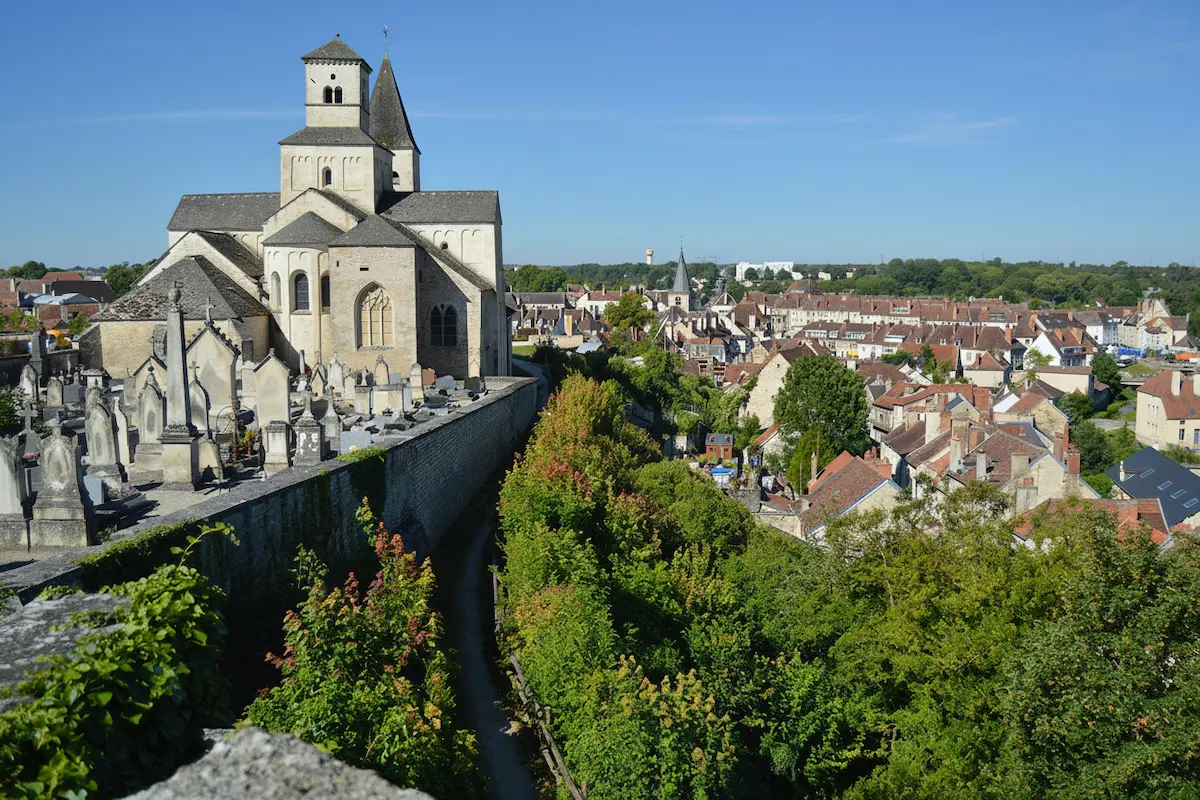


In short: Côte-d’Or is a welcoming destination for dogs, with many dog-friendly places to stay, many restaurants accepting dogs on the terrace, and wine estates that accept dogs (courtyard or tasting room). Dogs are accepted on public transport subject to conditions. Plan on a short lead in parks and tourist sites.
Côte-d’Or suits dog-friendly travel well. Its wide open countryside (Morvan, Auxois, vineyards), urban parks and quality visitor infrastructure make it a département where owners can explore without leaving their companion at home. This guide covers the rules, good addresses and precautions for a successful four-legged stay.
Dog-friendly accommodation
Hotels
Conditions vary enormously from one hotel to the next: supplement per night, maximum accepted size, ban on leaving the dog alone in the room, access refused to the breakfast room. The supplement ranges from free to about twenty euros per night, with no obvious link to the hotel’s standing.
These policies change too often to be reliable in a guide: call the hotel before booking and ask for the supplement to be confirmed in writing in the confirmation. Booking platforms let you filter on “pets allowed”, but that filter says nothing about the price or the real conditions.
Gîtes and holiday rentals
Rural gîtes are the most comfortable option with a dog, especially for week-long stays. The Gîtes de France label systematically indicates whether pets are accepted. Expect €300 to €700 per week for a 3–4 person gîte accepting dogs, with a flat supplement of €20 to €50 (cleaning).
Rental platforms (Airbnb, Abritel) let you filter by “Pets allowed”. Prefer properties with an enclosed garden, rarer in the vineyard (terraced houses, no land) but common in the Auxois and Châtillonnais.
Campsites
Most campsites in Côte-d’Or accept dogs (sometimes subject to size and breed restrictions). Those at Lac des Settons and on the Canal de Bourgogne are particularly welcoming. In a mobile home, the supplement is €3 to €8 per night. In a tent, access is often free or €2 per night.
Restaurants accepting dogs
The general rule in France: dogs are banned in restaurant dining rooms (except guide dogs for the blind), but accepted on terraces. In Côte-d’Or, most terraces are accessible to dogs on a lead.
In practice: ask the server as you arrive rather than once you are seated, choose a table at the end of the terrace away from the traffic, and bring your own bowl, as few establishments provide one. A dog lying under the table rarely bothers anyone; a dog blocking the way gets the next one refused.
Dijon’s and Beaune’s covered markets tolerate dogs on a lead in the aisles, but the Saturday morning rush makes them uncomfortable for the animal and other customers alike.
Vineyards and dogs: what you need to know
Policies vary from one estate to another, and often from one day to the next depending on who is hosting. Three cases come up again and again:
- Courtyard and garden: usually fine, keep the dog on a short lead.
- Tasting room: often accepted at family estates, refused where groups are hosted.
- Cellars and wineries: almost always refused, for good reasons (steep stairs, slatted floors, open vats during vinification, hygiene rules).
The only reliable method is to call ahead. Give the dog’s size: that is often what decides the answer.
Tips for your visit:
- Call before you set off: “Hello, I’d like to come and taste with my dog, is that possible?”
- Keep your dog on a short lead in the courtyard and tasting room
- Never leave them alone in the car, even in the shade (interior temperature: 50 to 70 °C in summer)
- Bring a collapsible bowl and water: cellars are 12–14 °C but tasting can last 30 minutes
Parks and green spaces
Dijon
All public parks in Dijon accept dogs on a lead. The main ones:
| Park | Area | Particularity | Water point |
|---|---|---|---|
| Jardin de l’Arquebuse | 5.4 ha | Dog on lead, lawns off limits | Yes (fountain) |
| Parc Darcy | 2 ha | Water play, carousel | Yes |
| Parc de la Colombière | 33 ha | Listed formal French garden, star-shaped paths | Yes |
Ban: dogs are not allowed in children’s play areas and protected botanical spaces. Dedicated dog parks (enclosures) remain rare in Dijon.
Beaune
Parc de la Bouzaize (5 minutes from the centre, 5 hectares) accepts dogs on a lead. Ideal for a break between visits. The banks of the Bouzaize offer a 4 km route along the river, perfect for a morning walk with your dog.
Morvan forests
The Parc naturel régional du Morvan is a paradise for dogs: forest trails, lakes, wide open spaces. Dogs must be on a lead outside forest paths from 15 April to 30 June (nesting and birthing season for mammals). The rest of the year, they may be off lead provided they respond to sight and voice. Hunting dogs in action may be off lead during the hunting season (September to February).
Rules to know
Public transport
The TGV accepts dogs of all sizes, but none travels free: you need an animal flat-rate ticket, from €10 per animal per journey, whatever the size. Small dogs (under 6 kg) travel in a bag or soft carrier max 45 x 30 x 25 cm, on your lap or at your feet. Dogs over 6 kg travel muzzled and on a lead, at your feet. Maximum two animals per passenger. Buy this ticket at the same time as your own: from the conductor it goes up to €20, and without a ticket the fine is €35. Guide dogs travel free, without a ticket or muzzle.
On TER Bourgogne-Franche-Comté, carrying animals falls under regional pricing, distinct from the TGV: check the current fare on ter.sncf.com before you leave. Dogs over 6 kg travel muzzled and on a lead.
Tram and Divia buses (Dijon) admit only small dogs carried in a closed bag or carrier (free). Large dogs, even muzzled, are refused, except guide dogs.
Dijon taxis generally accept dogs on a lead (about half a dozen companies): say so when booking.
Vaccinations and identification
Before travelling, check that your dog is identified (mandatory since 1999; a readable tattoo remains valid in France, but only the microchip lets you cross a border) and that vaccinations are up to date, especially rabies if you are coming from abroad. The European pet passport is accepted at all accommodation and on transport. No additional vaccination is required within mainland France.
Regulations in Côte-d’Or
- Lead mandatory on public roads and in public places: this follows from the departmental health regulations and municipal by-laws, not from the size of the commune.
- Ban in children’s play areas, cemeteries and schools.
- Fine for uncollected mess: €35 in Dijon (up to €150 in other communes).
- Ban on entering designated swimming areas at lakes (supervised beaches).
- Category dogs (1st category: Pitbull-type, Boerboel, Tosa; 2nd category: Rottweiler, American Staffordshire): muzzle and lead mandatory in all public places.
Hiking with your dog
Côte-d’Or trails are well suited to hiking with a dog. Main recommendations:
- Water: bring 1 litre of water for your dog (Morvan streams may be drinkable, but stagnant pond water should be avoided). A collapsible bowl is essential.
- Ticks: the Morvan and Auxois forests are infested with ticks from spring to autumn. Use a parasite treatment (collar, spot-on) before setting off and check your dog’s coat after every walk.
- Heat: in summer, do not walk your dog between midday and 4 p.m. Vineyards offer no shade. Stony ground can burn paw pads above 30 °C.
- Injuries: vineyard path stones can hurt unaccustomed pads. A city dog needs 2 to 3 days to adapt before walking on vine tracks.
Recommended routes with a dog:
- Lac des Settons loop (14 km, 4h): flat, regular water points, shaded. Easy.
- Sources de la Seine (short loop): shaded, river to cool off. Easy.
- Voie des Vignes (section) (5–10 km, 1h–2h): flat, but very little shade in summer.
- GRP des Grands Crus (17.7 km, 4h15, from Gevrey-Chambertin to Nuits-Saint-Georges): moderate, little shade, bring water for your dog.
Veterinary emergencies
Veterinary clinic details change regularly (on-call rotations, closures, practice takeovers). To find an open or on-call vet:
- During the day: ask your hotel or the tourist office. Most pet-friendly accommodations keep an up-to-date list.
- Emergency (nights, weekends): dial 3115, the free national veterinary emergency number, available 24/7. Give your postcode and you are put in touch with the nearest on-call vet. Do not call 15 or 112: they are reserved for human emergencies.
- Lost pet: report it on Filalapat, the search service of the national I-CAD identification register. It is not a directory of on-call vets: for that, use 3115.
- Pharmacies: on-call pharmacies often display the duty vet in their window.
In the Morvan and Châtillonnais, the nearest on-call vet may be 30–45 minutes away. Always keep a blanket, water, and your dog’s health record in the car.
Activities with your dog
City walks
Dijon’s historic centre is accessible with a dog on a lead. Cobbled streets (rue des Forges, rue de la Chouette) are manageable, but very small dogs may struggle on uneven paving. Dogs are not allowed inside Dijon museums (except guide dogs for visually impaired visitors). Want to visit a museum? Dog sitters and daycare services operate in Dijon and Beaune: ask your hotel or the tourist office for a recommendation, and book a few days ahead in high season.
Swimming
Dogs are banned on supervised beaches at Morvan lakes (Lac des Settons, Lac de Chamboux, Lac Saint-Agnan). Outside bathing zones (lake ends, unmarked banks), swimming is tolerated. Check with the relevant town hall. No exclusively dog-friendly beach exists in Côte-d’Or: unmarked banks remain the only option. Dijon’s public fountains are not water points for dogs: use your own bowl.
Guided tours
Some guided tours in Dijon and Beaune accept dogs. Ask the tourist office: audio-guided tours (Parcours de la Chouette, Dijon audioguide) work with a dog on a lead. Group tours (Hospices de Beaune) accept dogs on a lead except in peak season.
Frequently asked questions
Can I leave my dog alone at the hotel during a visit?
Can my dog use Dijon's public transport?
Do I need special paperwork to travel with my dog in Côte-d'Or?
How can I visit vineyards with my dog?
Another question?
Write to usSources
- Côte-d'Or Tourisme: Travelling with your dog
- Dijon Métropole Tourisme: Green spaces
- Beaune Tourisme: Walks with your dog
- Service-Public.fr: Dogs in forests: lead compulsory from 15 April to 30 June
- SNCF: Travelling with animals
- Préfecture de la Côte-d'Or: Animal regulations
- AniCura: Emergency vets in Côte-d'Or
- Dog-friendly Bourgogne: Accommodation and activities
- SNCF: TER Bourgogne animal access