







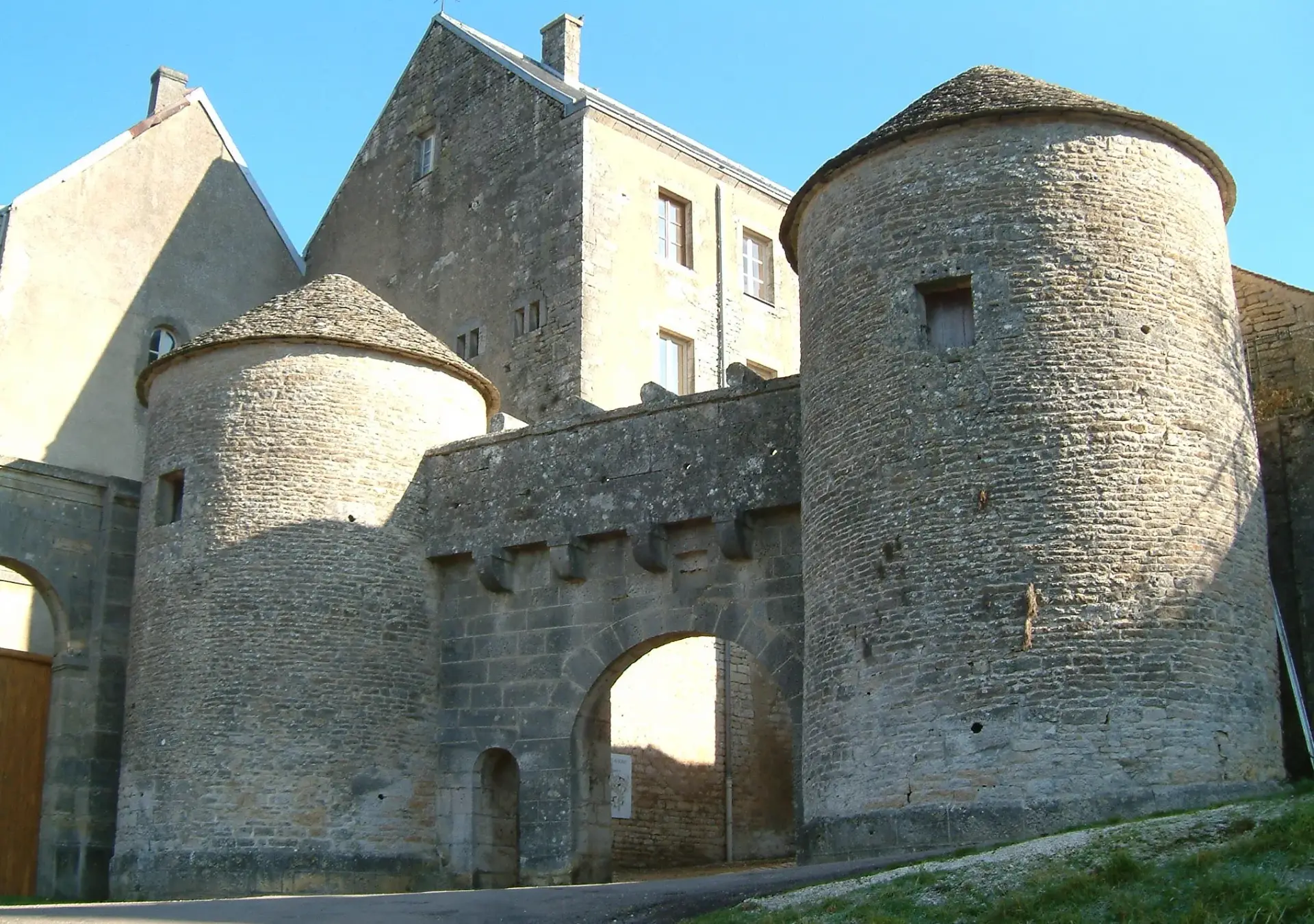


Perched on a pink granite outcrop at the heart of a meander of the Armançon River, Semur-en-Auxois is one of the best-preserved medieval towns in Burgundy. Former capital of the Auxois county, it displays its ramparts, towers and Gothic church in a setting that has crossed the centuries without losing its authenticity. This guide takes you through its monuments, history and the best ways to organise your visit.
Semur-en-Auxois: a thousand years of history
The first written record of Semur dates back to 606, in the founding charter of Flavigny Abbey, under the name sene muro, later evolving to sine muro - “without walls” in Latin, a paradox for a town that would become one of the strongest fortresses in Burgundy.
From capital of the Auxois to preserved town
The town grew in the 11th century when it became the capital of the Auxois county within the Duchy of Burgundy. In 1276, Duke Robert II granted Semur a communal charter, formalising the freedoms of its inhabitants. During the Hundred Years’ War, the Valois dukes significantly strengthened the fortifications, making Semur nearly impregnable.
In 1478, the town resisted the troops of Louis XI, who occupied it after a siege. A decisive turning point came in 1602: Henry IV ordered the dismantling of the fortifications. The town lost its military role but became the administrative seat of the Bailliage d’Auxois, a function it kept until 1926, when the sub-prefecture was moved to Montbard.
In the 19th century, architect Viollet-le-Duc restored the Notre-Dame church (1843-1855) and the ramparts (1843-1850), consolidating the appearance we see today. The town is classified as a Remarkable Heritage Site and features on any essential itinerary in Côte d’Or.
An intact architectural heritage
Semur-en-Auxois today has 3,986 inhabitants (2023), but its historic centre has preserved most of its medieval fabric: cobbled streets, half-timbered houses, 16th and 17th-century townhouses, wash-houses and shaded squares. The locally quarried pink granite gives the town a warm, distinctive hue that changes with the hours and seasons.
The ramparts and towers of the keep
Semur’s keep, rebuilt in the 13th century, is the defensive heart of the town. Although partially dismantled in the 17th century, it retains four monumental towers overlooking the Armançon valley.
The Orle d’Or tower
At 44 metres high with walls 5 metres thick at the base, the Orle d’Or tower is the symbol of Semur. Its name supposedly comes from a bird (“orle”) that crowned its roof - local legend tells of a golden eagle perched there. Since 1904, it has housed the Société des sciences, which holds its meetings and exhibits its collections there. Visitors can access it during the European Heritage Days and certain summer guided tours. The summit offers a 360° panorama of the Armançon meander and the wooded hills of the Auxois.
The other towers and the rampart walk
The three other towers of the keep are the Tour de la Gehenne (former salt granary), the Tour du Pin (former prison) and the Tour Margot, adjacent to the municipal theatre. The rampart walk, about 500 metres long, circles the keep and offers striking views of the river and the town’s rooftops. It is one of the most enjoyable routes for understanding the town’s defensive layout.
Practical tip: The best angle for photographing the towers and ramparts is from Pont Pinard, whose reflection in the water at the end of the day is one of Burgundy’s iconic images.
The Notre-Dame Church, jewel of Burgundian Gothic
Built from 1225, Notre-Dame Church is considered one of the purest examples of Burgundian Gothic architecture. Its nave, surprisingly narrow and tall for a church of this size, creates a verticality that impresses from the moment you enter.
Architecture and treasures
The facade, opening onto Notre-Dame square, is flanked by two square towers topped with balustrades. The three-portal porch dates from the 15th century. The transept is crowned with an octagonal bell tower topped with a 58-metre spire.
Inside, several elements deserve close attention:
- The Entombment: a polychrome sculpted group from the 15th century, depicting Christ surrounded by Nicodemus, Joseph of Arimathea, the Virgin and Saint John.
- The stone ciborium: a carved canopy, behind the pulpit, also dating from the 15th century.
- The north portal tympanum: it tells the story of Saint Thomas in India, based on Jacobus de Voragine’s Golden Legend.
Stained glass and organ
Some stained-glass windows date back to the 13th century. A window from 1927 commemorates the American soldiers who died during the 1914-1918 war. The classified grand organ retains elements from 1584, augmented in the 17th and 18th centuries.
The church has been listed as a Historic Monument since 1840, part of the very first list of protected monuments in France.
The Viollet-le-Duc restoration
Between 1843 and 1855, Viollet-le-Duc led a major restoration campaign. He consolidated the structures, restored missing sculpted elements and returned the church to its original Gothic appearance. Unlike some of his more controversial interventions (such as at Carcassonne), Viollet-le-Duc’s work at Semur is considered respectful of the original style and contributed to the building’s national recognition.
The municipal museum and other monuments
The Semur-en-Auxois museum
Housed in the former Jacobine convent (17th century), the municipal museum was founded in 1835 as a school of drawing, sculpture and architecture by sub-prefect Larribe. It is one of those “encyclopaedic” 19th-century museums where fine arts, natural sciences and archaeology coexist.
The collections are remarkable in several respects:
- Fine arts: a skylit gallery presents works from the 17th, 18th and 19th centuries, with painters such as Corot, Claude Vignon, Anne Vallayer-Coster and Étienne Bouhot, a native of the region and the school’s first director.
- Sculpture: the collection of original 19th-century plaster casts includes the original model of the Genius of Liberty by Augustin Dumont, the very same that crowns the July Column at Place de la Bastille in Paris.
- Palaeontology: over 10,000 specimens from the Lower Jurassic - the “Sinemurian” stage is actually named after Semur-en-Auxois.
- Archaeology: Gallo-Roman and medieval artefacts, including votive offerings from the Sources de la Seine.
- Cabinet of curiosities: a collection of shells, stuffed fish and other specimens typical of 19th-century museums.
Admission: EUR 4 (free for under-25s). Check opening times before your visit.
The municipal theatre and other monuments
Semur’s municipal theatre, rebuilt after a fire in 1901, is an Art Nouveau Italian-style theatre. Its horseshoe-shaped auditorium and decorative paintings make it a unique building for a town of this size.
Other monuments not to miss: the former general hospital (buildings from 1734 onward), the municipal library with 140 manuscripts including a Life of Saint Jerome dating from around the year 1000, and the many half-timbered houses scattered through the centre.
Walking around Semur: itineraries and activities
The 3 Enceintes trail
The tourist office offers a self-guided interpretation trail of 8 stops, marked on the ground. The booklet, available at the office (2 place Gaveau), explains the different defensive walls that protected the town from the 13th to the 17th century. Allow 1h30 to 2h for the full circuit.
The Chaumes loop
For hikers, the Tour des Chaumes is an 8 km loop climbing six hills on the left bank of the Armançon, offering panoramic views of the town. The start is from Pont Pinard. The elevation gain is moderate (about 150 metres), making the hike accessible to most walkers.
Family activities
Two activity booklets are available at the tourist office for children aged 4 to 7 and 7 to 11. They allow younger visitors to discover the town’s history through puzzles and scavenger hunts.
Around Semur: what to see in the Auxois
Semur is the ideal starting point for exploring northern Côte d’Or. Within 30 minutes by car:
- Flavigny-sur-Ozerain (15 km): one of the “Most Beautiful Villages of France”, famous for its Aniseed sweets and the film Chocolat.
- Fontenay Abbey (20 km): 12th-century Cistercian abbey, UNESCO World Heritage site.
- The Alesia site (25 km): the MuséoParc recounts the 52 BC battle with Vercingetorix’s statue.
- Bussy-Rabutin Castle (20 km): home of the letter-writer exiled by Louis XIV.
- Saulieu (40 km): gastronomic town and gateway to the Morvan.
Planning your visit
Getting there
- By car: A6 exits 23 (Bierre-lès-Semur) or 24 (Pouilly-en-Auxois), follow the D980. Free parking at place Gaveau.
- By train: TGV station Montbard (Paris-Montbard in 1h), then taxi. TER station Les Laumes-Alesia.
- By bus: Mobigo lines 119 to 122 from Dijon (1h15).
Tourist office
2 place Gaveau, 21140 Semur-en-Auxois Tel: +33 (0)3 80 97 05 96 Open Monday to Saturday 9:30-12:15 and 2:00-6:00 PM. Sunday (May to September) 10:00-12:30 and 2:00-6:00 PM.
When to come
The May to September period is best for guided tours, outdoor dining and summer events. Spring and autumn offer beautiful light on the pink granite and quieter crowds. In winter, Semur takes on a timeless atmosphere with its cobbled streets and misty rooftops.
Frequently asked questions
How long should I plan to visit Semur-en-Auxois?
What is the best time to visit Semur?
Is Semur-en-Auxois accessible by public transport from Dijon?
Another question?
Write to usSources