
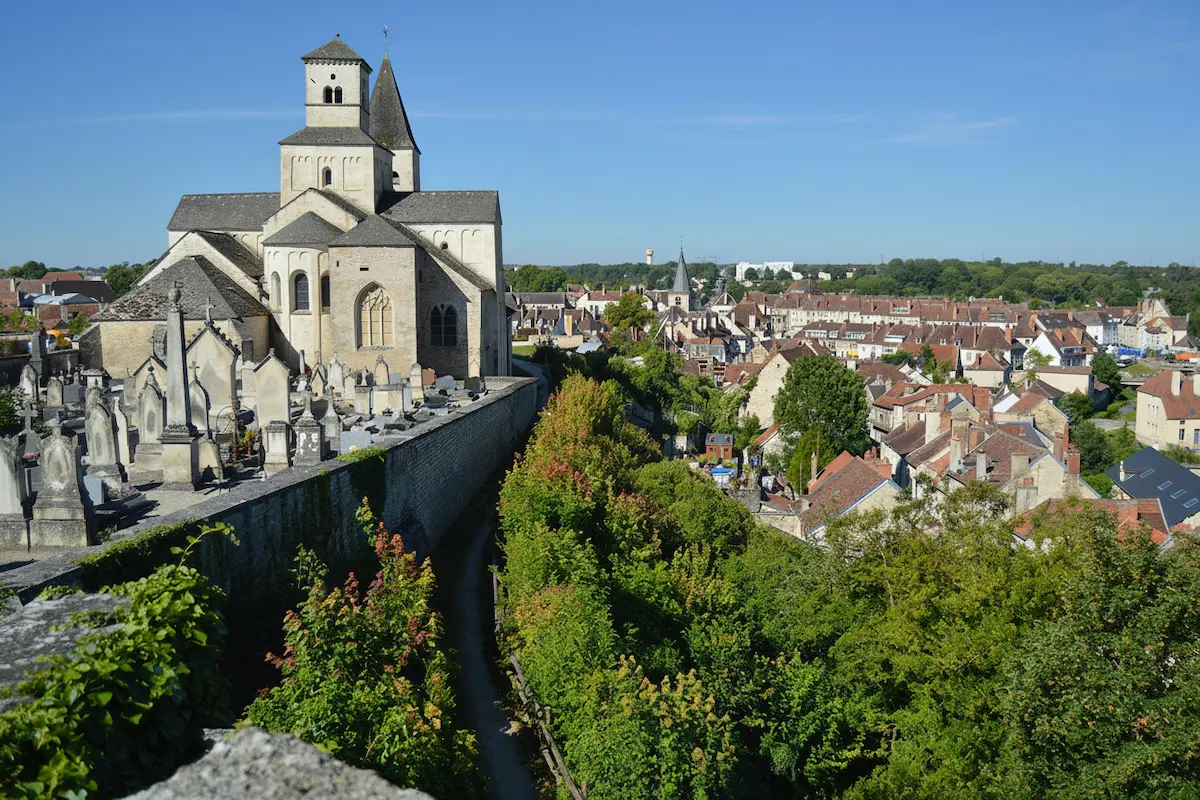


In short: Pommard is the second-largest wine-producing village in Burgundy after Beaune, with 337 hectares of vines planted exclusively to Pinot Noir. The appellation has no grand cru status (a historic choice from the early 20th century) but counts 28 premier crus, among which Les Rugiens and Les Epenots are often considered the qualitative equals of neighbouring grand crus. The Château de Pommard, an 18th-century estate, is home to Clos Marey-Monge, the largest monopole in the Côte de Beaune with 20 continuous hectares.
Pommard is a name that resonates with Burgundy red wine lovers. Lying between Beaune to the north and Volnay to the south, this village of 430 inhabitants (INSEE data 2023) boasts one of the highest concentrations of premier crus in Burgundy within a 10 km² area. Its structured, tannic wines, sometimes austere in their youth, are among the longest-aging wines of the Côte de Beaune.
A name from Roman antiquity
The most widely accepted etymology traces Pommard back to Pomona, the Roman goddess of fruit and orchards. Coins bearing the effigy of Nero discovered in the commune attest to Gallo-Roman settlement as early as the 1st century, and it is likely that vines were already cultivated here at that time. Later, the monks of Cluny and Cîteaux structured the vineyard, shaping the mosaic of climats as we know it today.
The Pommard appellation was officially recognised as an Appellation d’Origine Contrôlée on 11 September 1936, part of the very first batch of French AOCs created under the impetus of jurist Pierre Le Roy de Boiseaumarié, founder of the INAO.
28 premier crus, zero grand cru: the story of a deliberate choice
This is the most discussed peculiarity of Pommard: why does a village of such renown have no grand cru? The answer is historical. When the Burgundy wine classification was being drawn up in the early 20th century, the winegrowers of Pommard refused reclassification to grand cru for their finest climats, particularly Les Rugiens and Les Epenots, fearing additional constraints and higher land taxes. This administrative decision, never revisited since, means Pommard remains a village and premier cru appellation today, without the grand cru label - even though several of its parcels are regularly compared to the grand crus of the Côte de Nuits by professional tasters.
The village counts 28 premier crus across approximately 135 hectares, nearly 40% of its total appellation surface - one of the highest proportions in the Côte de Beaune.
The two giants: Les Rugiens and Les Epenots
Les Rugiens: absolute power
Located at the south-western edge of the village, towards Volnay, the Les Rugiens climat produces what many consider the most virile, structured Pommard. The clay-limestone soil, rich in iron oxide that gives the terroir its reddish tint (hence the name “rugiens”, evoking rust), imposes firm tannins that require a minimum of 8 to 10 years in the cellar before taming. On the palate, aromas of dark fruits, leather, pepper and chocolate interweave in a tight-knit fabric that evolves slowly.
Les Epenots: balance and elegance
To the east of the village, towards Beaune, the Les Epenots climat - subdivided into Grands Epenots, Petits Epenots and Clos des Epenots - offers a noticeably different style. Deeper, less ferruginous soils produce more supple wines, more aromatic in their youth, with better-integrated tannins. Aromas of crunchy red fruits (cherry, raspberry) and sweet spices dominate.
Le Grand Clos des Epenots
The Domaine de Courcel, historic owner of the Grand Clos des Epenots as a monopole, produces some of the most sought-after Pommard in the Côte de Beaune, with Pinot Fin vines averaging 50 years of age. This clos is considered by many critics to have grand cru potential, had the classification evolved differently.
Serving a Rugiens and an Epenots side by side perfectly illustrates the diversity of Pommard: the former embodies mineral power, the latter fruit-driven generosity.
Château de Pommard and Clos Marey-Monge
Built in 1726 by Vivant Micault, secretary to Louis XV, the Château de Pommard dominates the vineyard with its classical silhouette. Its estate, Clos Marey-Monge, is the largest wine-producing monopole in the Côte de Beaune: 20 continuous hectares, entirely walled, planted to Pinot Noir. The château now offers tastings, vaulted cellar tours and contemporary art exhibitions - its collection includes works by Dali, Picasso and Miró, displayed among the oak barrels.
The Route des Grands Crus, officially created in 1937, runs through the Pommard vineyard: an itinerary that has become legendary, in which the village holds a central place.
Estates and producers
Beyond Château de Pommard and Domaine de Courcel (Grand Clos des Epenots, Les Rugiens, Les Fremiers), several estates are worth visiting:
- Domaine Parent: one of the oldest in the village, with parcels in Les Epenots and Les Rugiens, known for its long élevage in partially new oak barrels.
- Domaine Vaudoisey-Creusefond: produces an Epenots renowned for its balance between power and finesse.
- Domaine de Montille: a historic Volnay estate that also owns parcels in Pommard, notably in Les Rugiens.
Most estates welcome visitors by appointment. Several wine shops in the village centre let you taste and compare several producers without moving from village to village.
Pairing Pommard at the table
A Pommard at the table calls for beef (steak, grilled, braised) or game (wild boar, venison) above all else. Its tannic structure demands robust dishes: coq au vin, a stew, or simply a piece of grilled red meat. For cheese, washed-rind varieties such as Époisses, Langres or Soumaintrain are ideal partners - the wine’s power stands up to the cheese without fading.
The ideal serving temperature is between 14 and 17 °C. For recent vintages (under 5 years), decanting for one hour is recommended to open up the aromas.
Visiting Pommard
The village itself can be explored in half a day. The Saint-Pierre church is easily spotted from afar by its square bell tower typical of Côte de Beaune wine villages. The narrow streets of the centre preserve winemakers’ houses from the 17th and 18th centuries, with their arched cellar doors.
Heading south out of the village, the D973 road descends towards Volnay through the vines of Les Rugiens and Volnay: one of the finest vineyard views in the Côte de Beaune. The Voie des Vignes, a cycle path linking Beaune to Santenay, passes through Pommard and offers a pleasant alternative to driving between villages.
Pommard lies 4 km south of Beaune and 45 km south of Dijon. Parking is free around the church square and along the D973 that runs through the village. The nearest TGV station is Beaune (6 km), with frequent TER connections.
Frequently asked questions
Does Pommard have any grand cru vineyards?
How long should you age a Pommard?
What is the difference between Pommard and Volnay?
Another question?
Write to usSources
- Bourgogne Tourisme - Route des Grands Crus
- Bureau interprofessionnel des vins de Bourgogne
- Route des Grands Crus - site officiel
- France.fr - Route des Grands Crus : 9 étapes
- Wikipedia - Pommard
- Château de Pommard - Site officiel
- Patrimoine Mondial UNESCO - Climats de Bourgogne
- La Cave Éclairée - All about Pommard
- Bourgogne Wines - Pommard appellation