



In brief: the Vix Treasure is one of the most important archaeological discoveries of Celtic Europe. Unearthed in 1953 at the foot of Mount Lassois, it comprises a bronze Greek krater of 208 kg (the largest metal vessel from Western classical antiquity), a massive 480 g gold torc and the chariot of a 6th-century BC Celtic princess.
During the winter of 1952-1953, archaeologist Rene Joffroy and his assistant Maurice Moisson excavated a tumulus at the foot of Mont Lassois, near the village of Vix, 6 km north of Chatillon-sur-Seine. Against all expectations, the tomb had never been looted. What they discovered transformed understanding of relations between Celts and the Mediterranean world in the Early Iron Age.
The Vix Krater, masterpiece of Magna Graecia
The centrepiece of the treasure is a bronze volute krater of unprecedented size: 1.64 m tall, 208.6 kg and a capacity of 1,100 litres. It is the largest known metal vessel from Western classical antiquity. Its body, hammered from a single sheet of bronze 1 to 1.3 mm thick, is a technical feat testament to the skill of Greek bronzesmiths.
The krater was made around 530 BC by Greek artisans: specialists hesitate between a workshop of Magna Graecia - possibly Sybaris, a city then at its peak - and a workshop of mainland Greece. Its decoration includes a frieze of eight chariots and hoplites running around the neck, handles adorned with Gorgon heads and a lid crowned by a draped female statuette 19 cm tall. The lid is perforated, serving as a wine strainer.
The vessel travelled more than 1,000 km before reaching Burgundy, disassembled into several elements marked with Greek letters for transport. It likely followed the Rhone and Saone route from Marseille, then up the Seine to Mont Lassois, which controlled a major trading crossroads between the Mediterranean world and Northern Europe.
The tomb of the Lady of Vix
The deceased, aged 30 to 35, lay on the platform of a dismantled chariot whose wheels had been placed beside her. Anthropological analysis indicates a tall, healthy woman with no signs of violence. Her exceptional status is confirmed by the richness of her grave goods.
Besides the krater, the tomb contained:
- A massive gold torc of 480 g, made of 24-carat gold, found around the skull and long interpreted as a diadem. It is one of the largest gold torcs of Celtic antiquity.
- A second bronze torc.
- Six fibulae (brooches), some decorated with amber, coral and gold leaf.
- Six shale bracelets and a bronze bracelet with amber beads.
- An exceptional banquet service: a silver phiale (libation bowl), an Etruscan bronze oinochoe (wine jug) and two Attic ceramic cups, one dated to about 525 BC, providing a terminus post quem for dating the tomb.
The absence of weapons confirms this is a female burial. The combination of Greek, Etruscan and Celtic objects makes Vix a unique burial in Europe, unmatched for its concentration of Mediterranean imports.
The Mont Lassois oppidum, Celtic princely palace
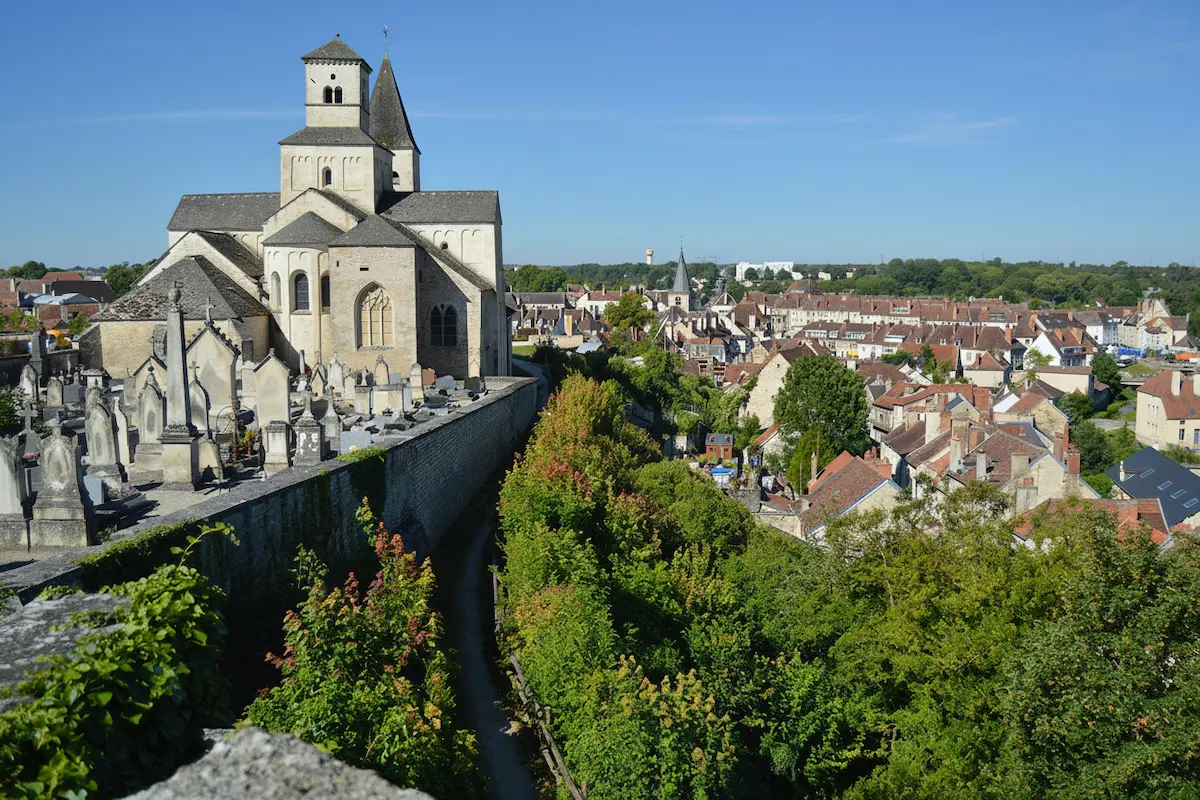
Mont Lassois is a fortified hill dominating the Seine valley, which constituted in the Hallstatt period (6th-5th century BC) a Celtic oppidum of the first order. A vast 42-hectare necropolis stretched to the south-east of the hill. The site controlled a key trading node where the Seine - a river route to the north - crossed the land route linking the Mediterranean to Northern Europe for the trade of tin, amber and wine.
The fortifications, impressive, reached up to 8 m thick using the Pfostenschlitzmauer technique (vertical post wall). In 2006, excavations uncovered a vast palatial complex at the centre of the oppidum, with a main building of 35 m × 22 m and an estimated height of at least 15 m, whose megaron plan directly evokes Greek palaces of the same period. Nicknamed the “Palace of the Lady of Vix”, it is without equivalent in the Hallstatt Celtic world.
Since 2001, a Collective Research Programme titled “Vix and its environment” has brought together French, German, Austrian and Swiss teams, continuing the study of the site and its territory.
Where to see the Vix Treasure
The Vix Treasure is displayed at the Museum of Pays Chatillonnais in Chatillon-sur-Seine (see the dedicated page). The krater, gold torc and all the grave goods are presented in a specially designed room, with a scenography that highlights the archaeological context of the discovery.
Mont Lassois and the oppidum remains are accessible outdoors, with an interpretation trail explaining the organisation of the princely site. The tumulus itself is visible from the road. The climb to the summit offers a remarkable panorama over the Seine valley and the Chatillonnais.
Practical information
Access and hours
The museum is closed from January to February, as well as on Tuesdays outside peak season. Allow 1.5 to 2 hours for the full visit of the collections, including the Vix Treasure room. The Mont Lassois interpretation trail requires 1 hour extra, with a moderate climb. Wear suitable shoes for the outdoor archaeological site.
For those wishing to go further, the National Archaeology Museum in Saint-Germain-en-Laye holds casts of the krater and presents the context of Hallstatt Celtic principalities in its permanent collections. Several contemporary princely sites are visible in Europe - Heuneburg (Germany), Hochdorf (Germany), Glauberg (Germany) - but none has yielded a vase as monumental as the Vix Krater.
Frequently asked questions
Where can I see the Vix Treasure today?
Who was the Lady of Vix?
Why is the Vix Krater exceptional?
Another question?
Write to usSources