



In short: with around 45 bed-and-breakfast rooms within the walls, Dijon offers a credible and often more authentic alternative to conventional hotels for a cultural city break. From lodging in a 17th-century hôtel particulier at the foot of the Palais des Ducs to a mansard room in the antiquaires quarter, district choice matters. This guide covers the three main B&B areas in Dijon, historic centre, antiquaires quarter, Maladière, to help you choose according to your visit plans.
Dijon bed and breakfast has grown markedly over a decade. While conventional hotel stock in the Dijon metro area remains stable (around 1,800 hotel rooms, mostly 2 and 3 star), the number of labelled or listed B&Bs has risen to around 45 addresses today. That growth meets demand for more personalised stays, where welcome, homemade breakfast and local tips matter more than standard hotel services.
Staying in a Dijon B&B changes several aspects of the trip compared with a hotel. The first is location: B&Bs are almost all in Dijon’s protected sector (97 hectares listed since 1966), at the heart of the historic centre, within walking distance of the Palais des Ducs, Les Halles, rue des Forges and the Musée des Beaux-Arts. The second is breakfast: included in the nightly rate, prepared by the host with local produce, often a step above a standard hotel buffet. The third is the relationship with the host, who gives personalised advice, sometimes an informal guided tour or an up-to-date notebook of restaurants and market producers.
Historic centre: sleeping in the shadow of the Palais des Ducs
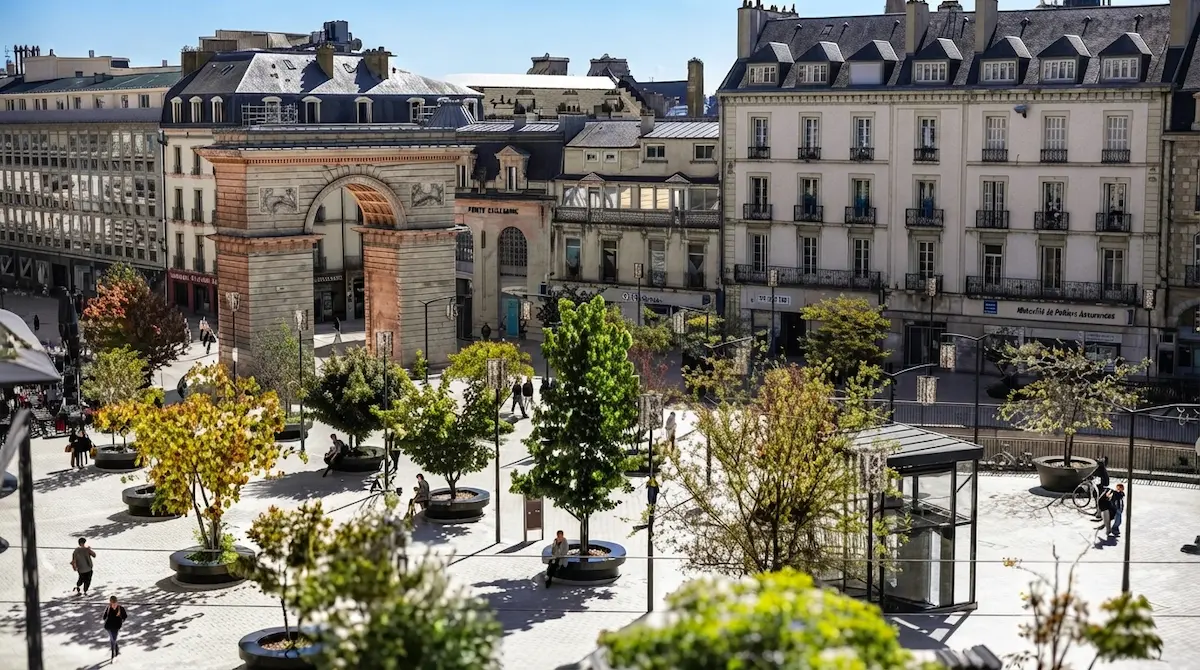
The core of the protected sector, between place Darcy, the Palais des Ducs and Saint-Bénigne cathedral, has the highest density of Dijon B&Bs. This perimeter of less than one square kilometre holds the city’s oldest streets, rue des Forges, rue de la Chouette, rue Verrerie, rue Vauban, and main monuments: the Palais des Ducs et des États de Bourgogne (17th–18th century), Notre-Dame church (13th century with its gargoyle façade), Musée des Beaux-Arts (one of France’s richest museums), Tour Philippe le Bon (316 steps for a panoramic view over Dijon’s roofs and wine slopes).
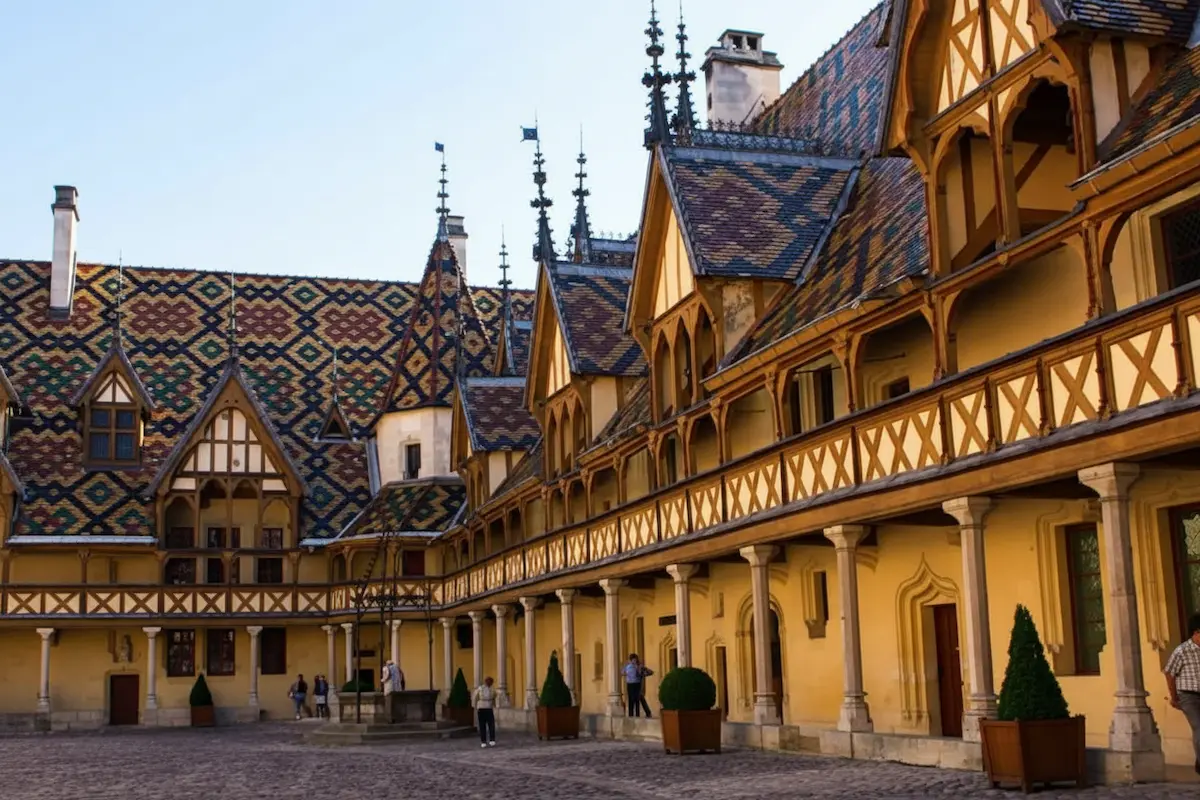
Historic-centre B&Bs occupy 17th- and 18th-century buildings, often listed or registered monuments. The fabric is that of the Dijon hôtel particulier: Burgundy limestone, glazed flat tile roofs, small-paned windows, stone stairs with wrought-iron railings. Rooms are usually upstairs, sometimes in the attic with exposed beams, with ceiling heights often above 3 metres. Size ranges 18–35 m², with en-suite bathrooms fitted in the old dressing room or an adjoining room.
Prices in the historic centre are the highest in Dijon for B&B: expect €90–140 a night for two, breakfast included, in 2025–2026. The upper range matches the best-located rooms (rue des Forges, place de la Libération) or those with a remarkable view; mansard or courtyard-facing rooms sit in the lower range. Breakfast in this sector is generally careful: Dijon pain d’épices, cassis or raspberry jam from Burgundy, country bread, AOP Charentes-Poitou or Bresse butter, fresh cheese, local apple or grape juice, coffee roasted in Dijon.
The main drawback of historic-centre B&Bs is noise. Pedestrian and semi-pedestrian streets stay busy until late, especially in summer, and old windows are not always double-glazed. Hosts often provide thick curtains and fans, rarely air conditioning (absent from most listed buildings). Noise-sensitive travellers should favour courtyard-facing rooms or quieter streets such as rue Vauban or rue Charrue.
The antiquaires quarter: charm B&B between Les Halles and the cathedral
A historic area with relative quiet
The antiquaires quarter, centred on rue des Forges, rue Verrerie and place Saint-Michel, forms a triangle between Les Halles (19th-century covered market) and Saint-Bénigne cathedral. It takes its name from some thirty antique dealers, brocanteurs and galleries on ground floors of old buildings. This is the Dijon sector with the highest concentration of charm B&Bs, especially in fully restored hôtels particuliers with inner courtyards, secret gardens and balustraded stairs.
The main advantage over the historic core is relative quiet: streets see fewer pedestrians, café terraces close earlier, yet Les Halles remain three minutes on foot and the Palais des Ducs five. B&B distribution by quarter shows the antiquaires sector with around 15 of the 45 listed in the city, the second pole of chez l’habitant accommodation after the historic centre.
Antiquaires-quarter B&Bs share common traits: lodging in a 17th–18th-century building, often only one or two rooms per address, careful décor mixing period and contemporary furniture, en-suite bathroom with walk-in shower or claw-foot bath, high-speed wifi, and sometimes a small garden or courtyard. The limited room count (rarely more than three per house) ensures a tranquillity and intimacy that hotels in the same bracket struggle to match.
Prices and facilities by room type
Rates in the antiquaires quarter are comparable to the historic centre for equivalent service: €85–130 a night for two, breakfast included. The gap with the historic centre is mainly seasonal: antiquaires rooms tend to keep steadier year-round prices, while historic-centre ones vary more with events (International Gastronomy Fair early November, Fêtes de la Vigne in September, Saint-Vincent Tournante in January).
Typical facilities include quality bedding (160×200 or 180×200 mattress at 4 épis), en-suite bathroom, courtesy tray with kettle and tea, flat-screen TV, wifi, and sometimes private parking or a bike garage. Gîtes de France 3- and 4-épi B&Bs add bed linen, daily housekeeping and welcome products (shower gel, shampoo, soap). Some addresses offer extras: breakfast served until 10.30 a.m., picnic basket on request, bikes available, station transfer.
The antiquaires quarter is also where you find B&Bs best suited to reduced-mobility guests: several ground-floor rooms in hôtels particuliers have been renovated to accessibility standards, still rare in old Dijon buildings. Check when booking, as layout (narrow stairs, no lift) can be a barrier for wheelchair users or guests with limited mobility.
Maladière quarter and fringe: an economical alternative
A residential area in transition
Maladière, north-west of the centre, between jardin Darcy and parc des Comtes de la Salle, is the third B&B sector in Dijon. Less touristy than the centre or antiquaires quarter, it offers chez l’habitant lodging in town houses and 19th- and early 20th-century blocks, 10–15 minutes on foot from the Palais des Ducs. B&Bs are fewer (around ten addresses) but cheaper: €70–95 a night for two, breakfast included, 20–30% less than the historic centre.
Maladière clientele is mixed: business travellers drawn by proximity to the exhibition centre and Zénith de Dijon, budget-conscious families visiting the city, walkers and cyclists passing through on EuroVelo 6. Facilities are more variable than in the centre: some B&Bs match protected-sector standing (premium bedding, refurbished bathroom, careful décor), others sit in a more modest bracket, with shared facilities in the cheapest rooms.
Station quarter and Fontaine-d’Ouche: the practical choice
Dijon’s near fringe, especially the station quarter (south of the centre) and Fontaine-d’Ouche (west, on tram T1), offers another ten or so B&Bs at lower rates. The station quarter, undergoing urban renewal with the Gare-Porte Neuve ZAC, benefits from immediate proximity to Dijon-Ville TGV station (1 h 35 from Paris Gare de Lyon, 1 h 30 from Lyon Part-Dieu) and place Darcy, gateway to the protected sector. B&Bs are often in large Haussmann-style flats on boulevards near the station, at €60–85 a night.
Fontaine-d’Ouche, less central, is served by tram T1 to the centre in 15 minutes. B&Bs are scarce but offer Dijon’s best value: from €55 a night for a room with breakfast. This sector suits travellers with a car (easier free parking than in the centre) or stays combining Dijon visits with trips into the wine Côte.
Advantages of chez l’habitant for a city break
Choosing B&B over a hotel for a Dijon stay changes several practical aspects. The first is your relationship with the city: the host gives personalised tips not found in guides, the best day for Les Halles market, the restaurateur whose mother makes the bœuf bourguignon, peak hours at the Musée des Beaux-Arts, the wine merchant who opens barrels on Saturday morning. This informational capital, built over years of welcoming guests, is hard to quantify but changes the quality of the stay.
The second is the Dijon breakfast: served at table, often with other guests, it allows exchange of visit tips and addresses. The practice becomes an informal briefing moment, all the more valuable as Dijon is a city where gastronomic culture is a strong identity marker.
The third is flexibility: most Dijon hosts adapt to arrival and departure times, will keep luggage after check-out, and can suggest last-minute activities. That flexibility is rare in standard hotels and makes a difference on a short stay when every hour counts.
Dijon without a car: B&B at the heart of the protected sector
One practical aspect distinguishes Dijon B&B from rural ones in the surrounding countryside: almost no need for a car. Dijon’s protected sector, listed since 1966 over 97 hectares, is built for walking. Public car parks are scarce, expensive and often full by day. The city has developed a tram network (two lines, T1 and T2) linking the station, centre, university campuses and outer districts, plus a bike-share scheme (DiviaVélodi, 40 self-service stations, €0.50 per trip for short-term subscribers).
For a stay in B&B within the protected sector, the ideal is to arrive by train at Dijon-Ville, reach your accommodation on foot or by tram (10 minutes max from the station), and walk everywhere during your stay. The historic centre is compact: the Palais des Ducs is 10 minutes from the station, Les Halles 15, Musée des Beaux-Arts 12, Saint-Bénigne cathedral 7, rue des Forges 5. The outer ramparts trace of the medieval wall form a circular boulevard along promenades Darcy, du Chanoine-Bardot and du Souvenir, walkable in an hour.
For guests arriving by car, parking is a point to check when booking: some historic-centre B&Bs offer a private garage (often in a basement, accessed by car lift) for a few euros per day. The public car parks nearest the protected sector (Darcy, Grangier) charge by the hour. It is usually cheaper to leave the car at a park-and-ride on the outskirts and reach the centre by public transport.
Frequently asked questions
What is the average price of bed and breakfast in Dijon in 2026?
Is bed and breakfast in Dijon better than a hotel for a city break?
Do you need a car to stay in bed and breakfast in Dijon?
Do labelled Dijon B&Bs serve local produce at breakfast?
Another question?
Write to usSources
- Gîtes de France Côte-d'Or - Chambres d'hôtes Dijon
- Ville de Dijon - Site patrimonial remarquable / Secteur sauvegardé
- Patrimoine Dijon - Hôtels particuliers
- OT Dijon Métropole - Chambres d'hôtes
- Wikipédia - Histoire de Dijon
- Bourgogne Tourisme - Chambres d'hôtes à Dijon
- ADN Tourisme - Tendances hébergement chez l'habitant 2025
- Wikipédia - Secteur sauvegardé de Dijon
- INSEE - Capacité d'accueil Dijon Métropole