
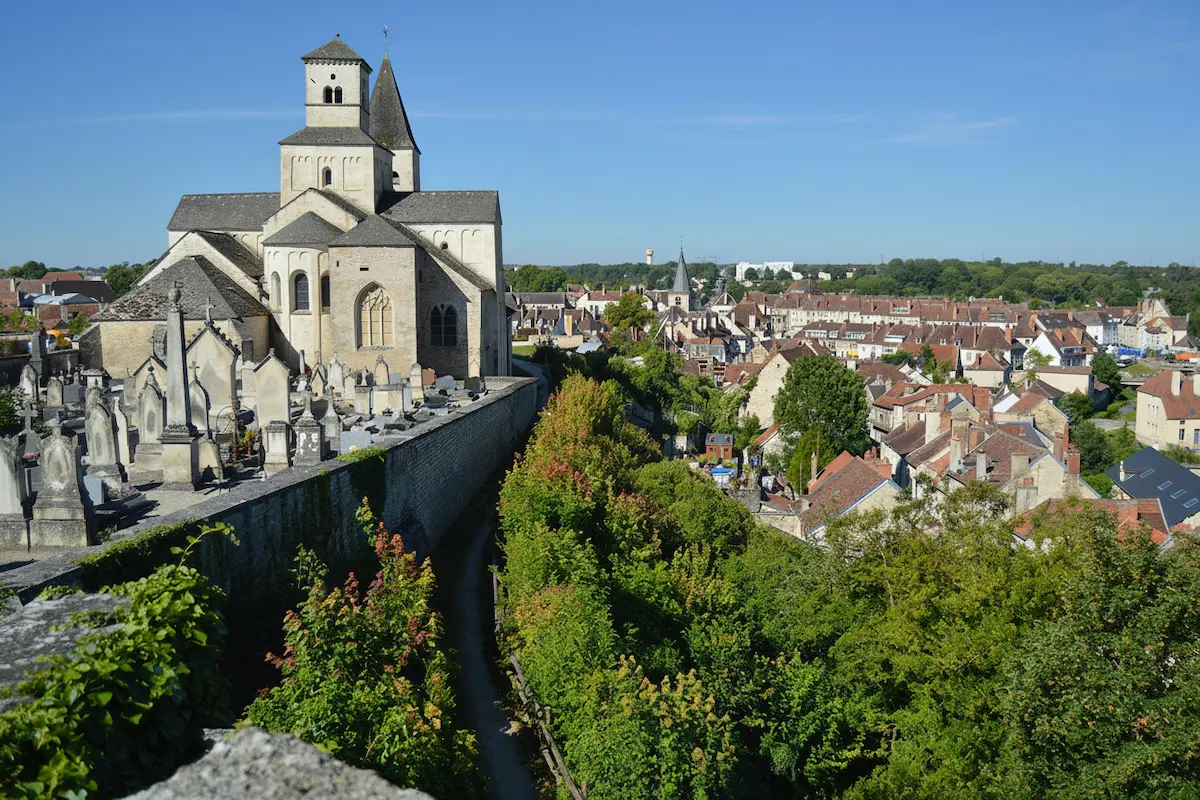


Straddling Côte-d’Or, Nièvre, Yonne and Saône-et-Loire, the Morvan Regional Nature Park is one of the oldest regional nature parks in France - established in 1970. With its nearly 3,300 km² of deep forests, dark-watered lakes and wind-swept granite ridges, the Morvan is an island of wilderness at the heart of Burgundy. A favourite destination for hikers, mountain bikers and nature lovers, this ancient massif - the last foothill of the Massif Central - cultivates a strong identity shaped by granite, water and preserved traditions.
Discover the Morvan Regional Nature Park
The Maison du Parc in Saint-Brisson: an essential starting point
To understand the Morvan before venturing into it, there is one address: the Maison du Parc in Saint-Brisson. This interpretation centre features a permanent exhibition on the geology, wildlife, flora and human history of the massif. Visitors can discover how the differential erosion of granite shaped the famous “chaos” rock formations - those piles of rounded boulders that dot the Morvan ridges. The park welcomes over 50,000 visitors each year and organises themed guided outings - ornithology, mushrooms, stargazing - accessible to all ages.
A marked 2.5 km interpretation trail starts from the Maison du Parc and crosses different environments: beech forest, wet meadow, heather moorland. Allow one hour for the loop - an ideal introduction to the massif.
Haut-Folin: roof of the Morvan
At 901 metres above sea level, Haut-Folin is the highest point of the Morvan. Its wooded summit offers no panoramic view - the trees hide the horizon - but the wooden observation tower built on site allows you to rise above the canopy. On a clear day, the view carries over kilometres of forest as far as the eye can see. The climb from the La Loge des Gardes car park is a 30-minute walk (yellow markers). In winter, Haut-Folin welcomes the Morvan’s few skiers: an alpine ski slope and a cross-country ski trail network are maintained here.
Mont Beuvray and Bibracte: a major Gallic site
Mont Beuvray (821 m) is not just a summit: it is one of Europe’s major archaeological sites. This is where Bibracte once stood, the fortified capital of the Gallic Aedui tribe, extensively described by Julius Caesar in The Gallic Wars. Excavations, which began in the 19th century and continue every summer, have uncovered ramparts, dwellings, artisan workshops and public squares. The Bibracte museum, at the foot of the mountain, presents the finds in a modern, immersive display. The site is classified as a Grand Site de France and attracts over 40,000 visitors per year.
Two marked trails climb to the summit from the museum: the Gauls trail (2 km, 1 hour, easy) and the Ramparts trail (4 km, 1h30, intermediate). Both offer superb views over the Morvan forest.
The lakes of the Morvan: a string of water and forest
The Morvan Park counts over 20 lakes and bodies of water, most of them man-made (reservoirs for timber floating, then for hydroelectricity and leisure). Each has its own character:
- Lac des Settons: the most famous (366 hectares), an artificial reservoir created in 1858 to supply timber floating to Paris. Now a water sports centre with swimming, beaches and a 14 km loop trail.
- Lac de Panthier: a 130-hectare lake, less crowded, with a lovely south-west-facing beach. Sailing, fishing and hiking.
- Lac de Chamboux: a small 85-hectare reservoir, family-friendly and good for fishing, calm water and wooded shores.
- Lac de Saint-Agnan: 140 hectares, swimming, leisure centre, aquatic wildlife discovery trail.
- Lac du Crescent: a 165-hectare reservoir, one of the wildest, dominated by forest.
Each lake has a car park, a supervised beach in season and a drinking water point. The water quality is good (class A or B according to the Regional Health Agency).
Hiking in the Morvan: the finest trails
The GR 13: crossing the massif
The GR 13 connects the Gâtinais (Seine-et-Marne) to the Morvan (Saône-et-Loire) over 462 kilometres, crossing the massif from north to south. This is the historic route for discovering the massif in all its diversity. The most remarkable sections:
| Section | Distance | Elevation gain | Points of interest |
|---|---|---|---|
| Saint-Brisson - Château-Chinon | 18 km | 590 m | Maison du Parc, Lac des Settons |
| Château-Chinon - Mont Beuvray | 22 km | 620 m | Wooded ridges, panorama |
| Mont Beuvray - Autun | 20 km | 530 m | Bibracte, Forêt de l’Éduen |
The GR 13 is marked in white and red. It can be walked in day sections, or over several days in its entirety.
A granite landscape
The Morvan ridges (crêts)
The crêts - alignments of rounded granite rocks - are the landscape signature of the Morvan. The most spectacular are found in the west of the massif. Several marked trails cross them, offering open views over the forested massif. These granite chaos formations are also popular with climbers, with boulders equipped up to 6 metres high.
Wildlife and flora of the Morvan Regional Nature Park
Large and small mammals
The Morvan is one of the last refuges of the wildcat (Felis silvestris) in Bourgogne-Franche-Comté. You may also encounter roe deer, wild boar (very abundant), red deer and pine marten. The Eurasian otter, returning over the past decade, frequents the most preserved waterways. The park runs a monitoring and protection programme for these species, with participatory surveys open to visitors.
Notable birdlife
The forests and moorlands of the Morvan are home to emblematic birds of prey: the red kite (Milvus milvus), the hen harrier, the common buzzard and the northern goshawk. The lakes host the great crested grebe, the grey heron and, during migration, the common crane. 160 breeding bird species are recorded in the park’s territory. Several observation hides (Lac des Settons, Étang du Taureau, Forêt de l’Éduen) allow watching without disturbing.
Typical flora
Beech and fir forests dominate the massif, with an understorey of bilberries, ferns and foxgloves. Heather and broom moorlands cover the ridges. The park hosts several protected species such as clubmoss and Morvan spleenwort (Asplenium billotii), a rare fern that grows on granite outcrops.
Morvan culture and traditions
Language and crafts
The Morvan has preserved a strong cultural identity. Morvandiau - a dialect of the Langue d’oïl - can still be heard in villages, though it is in sharp decline. The Morvan veillées (evening gatherings), once moments of storytelling and music, are being revived by associations that organise summer storytelling evenings. The Museum of Wet Nurses and Children of Public Assistance in Alligny-en-Morvan tells a poignant chapter of local history: the exodus of Morvan wet nurses to Paris in the 19th and 20th centuries - there were thousands of them at the height of the phenomenon.
Morvan gastronomy
Morvan cuisine is generous and rustic: jambon à la choux (braised ham with cabbage), œufs en meurette (local version of poached eggs in red wine), and forest honeys - the Morvan is a land of beekeeping. Charolais beef is raised outdoors, and the goat cheeses from the Fermiers du Morvan are well worth the detour.
Crafts
Granite has shaped Morvan architecture and craftsmanship. Lauze roofs (slate or granite slabs) and carved granite wayside crosses are typical of the massif. Several stonecutters continue the tradition, notably around Saint-Léger-de-Fougeret and Moux-en-Morvan.
Preparing your visit to the Morvan Regional Park
Getting there
The Morvan is accessible by car via the A6 motorway (Avallon or Bierre-lès-Semur exits) and the RN 6. The nearest TGV station is Montbard (Paris in 1h10), then car rental is essential. By regular train, the Avallon (north) and Corbigny (west) stations serve the park.
Where to stay
- Rural gites: over 120 accommodations certified Gîtes de France in the park’s territory.
- Bed and breakfasts: around thirty addresses, several of which are labelled Bienvenue à la Ferme.
- Campsites: by the lakes (Settons, Panthier, Saint-Agnan) and on farms.
- Hotels: mainly in Saulieu, Château-Chinon and Autun (the latter in Saône-et-Loire).
Seasonal tips
| Season | Top activity | Average temperature |
|---|---|---|
| Spring | Hiking, bilberry blossom | 8 - 16 °C |
| Summer | Swimming, sailing, mountain biking | 15 - 25 °C |
| Autumn | Forest colours, mushrooms | 6 - 15 °C |
| Winter | Cross-country skiing, frosty landscapes | -2 - 5 °C |
Annual events
- Fête du Morvan (July): traditional music, local produce, craft demonstrations.
- Journées du Patrimoine de Pays (June): tours of farms, mills and artisan workshops across the park.
- Nuits des Étoiles (August): astronomy observations from the Maison du Parc, certified as an International Dark Sky Reserve.
What is the best time to visit the Morvan Park?
Spring (May-June) and autumn (September-October) offer the finest light and pleasant temperatures for hiking. Summer is ideal for water activities on the lakes, while in winter the Morvan dons mist and frost - perfect for photographers.
How long do you need to explore the Morvan?
A weekend is enough to visit the Maison du Parc, a lake (Settons or Panthier) and a short hike. For a full experience including Haut-Folin, Mont Beuvray and local traditions, allow 3 to 4 days.
Is the Morvan Park suitable for children?
Yes, many activities are family-friendly: supervised swimming at Lac des Settons, interpretation trails around the Maison du Parc and easy walks along the ridges. The Bibracte museum offers workshops for ages 6-12.
Can you stay overnight in the Morvan Park?
The park offers a wide range of accommodation: rural gites, bed and breakfasts, lakeside campsites and hotels in Saulieu, Château-Chinon or Autun. The park map lists over 200 certified accommodations.
Why visit the Morvan Regional Nature Park?
The Morvan is not a destination you pass through. You come to it deliberately - for its endless forests, its lakes where the water seems black beneath the grey sky, its wind-swept ridges and its granite villages where Morvandiau is still spoken. This is a territory that does not give itself away at first glance - you must walk, stop, listen to the black woodpecker drumming on a beech tree. An hour and a half from Dijon and three hours from Paris, it is one of the largest areas of wild nature accessible from the capital. For lovers of hiking, Gallic history and crisp air, the Morvan Park is a must.
Frequently asked questions
What is the best time to visit the Morvan Park?
How long do you need to explore the Morvan?
Is the Morvan Park suitable for children?
Can you stay overnight in the Morvan Park?
Another question?
Write to usSources