


In 52 BC, a decisive battle changed the course of Gaul’s history. On the oppidum of Mont-Auxois, near present-day Alise-Sainte-Reine, the Gallic chieftain Vercingetorix faced the legions of Julius Caesar for the last time. Alesia is not only a major site of ancient history: it is also a key archaeological site, an immersive museum and the ideal starting point for understanding Gallic resistance. This guide gives you everything you need to plan your visit.
Alesia: the battle that changed Gaul
Caesar’s most ambitious siege
In the summer of 52 BC, Vercingetorix and his 80,000 men took refuge in the oppidum of Alesia, the natural fortress of the Mandubii. Julius Caesar had 10 to 12 legions - about 50,000 to 70,000 soldiers - plus Germanic auxiliaries. Rather than launching an assault, the Roman proconsul ordered the construction of a double fortification system: a contravallation of about 15 kilometres facing the besieged, and a circumvallation of more than 20 kilometres to protect against the relief army:
- A contravallation (inner line) to prevent sorties by the besieged.
- A circumvallation (outer line) to protect against the Gallic relief army.
The fortifications included wooden towers, ditches, traps and palisades. Caesar himself describes this system in his Commentaries on the Gallic War.
The relief army and the surrender
A Gallic relief army of nearly 240,000 men tried to break the siege. After several assaults repelled by the entrenched legions, the relief force withdrew. Vercingetorix, starving and short of supplies, surrendered to Caesar. The Gallic chieftain’s surrender marked the turning point of the Gallic Wars. Gaul became a Roman province, and Alesia was rebuilt as a prosperous Gallo-Roman town, with a forum, basilica, baths and temples, whose remains are still visible today.
The MuséoParc Alésia: an immersive journey into history
Bernard Tschumi’s interpretation centre
Inaugurated in March 2012, the MuséoParc Alésia interpretation centre is an architectural feat by Bernard Tschumi. The circular building, 52 metres in diameter and 1,200 m², is built from wood, stone and glass. Its green roof, planted with birch and oak trees, blends it literally into the landscape - a deliberate choice to be “visible and invisible” at once, respectful of the archaeological site.
Inside, the permanent exhibition presents over 600 archaeological objects: Gallic and Roman weapons, coins, jewellery and tools. Life-sized reconstructions, models and immersive films tell the story of the siege. Since 2021, the renovated tour has included augmented reality experiences: animated Roman fortifications on the battlefield and an immersive sound show.
The Gallo-Roman remains on Mont-Auxois
3 km from the interpretation centre, the Mont-Auxois plateau preserves the ruins of the Gallo-Roman town built after the conquest. You can discover a sanctuary and forum, an ancient theatre, a basilica and baths, as well as the Monument of Ucuetis, a unique building with its underground chamber.
Access to the remains is included in the entry ticket. 3D digital tablets are available for the visit.
The statue of Vercingetorix
Erected in 1865 by Napoleon III, the colossal statue of Vercingetorix overlooks the Laumes plain. The work of sculptor Aimé Millet, it stands 6.60 metres high on a 7-metre base designed by the architect Viollet-le-Duc. The statue shows a defeated but proud chieftain, resigned, arms crossed.
The base bears a famous inscription: “United Gaul, forming a single nation, animated by a common spirit, can defy the universe.” An apparent paradox, since the statue shows precisely the defeat of this “united Gaul” against Rome.
The great excavations of Napoleon III
The identification of Alise-Sainte-Reine as the site of the Battle of Alesia owes much to Napoleon III. Passionate about Julius Caesar’s history, the emperor created the Commission of the Topography of Gaul in 1858 and launched large-scale excavations in 1861. Up to one hundred workers worked simultaneously on the site.
The discoveries were considerable: Gallic and Roman weapons, coins attesting to the varied origins of the engaged peoples, skeletons and traces of Roman fortifications. A first museum was built as early as 1861-1862, funded by the imperial treasury, to house the discovered objects.
Modern excavations (1991-1997)
Recent Franco-German excavations led by Michel Reddé and Siegmar von Schnurbein (1991-1997) confirmed the quality of the 19th-century work and uncovered new elements of the siege system, including sling bullets marked with the name of Labienus, Caesar’s lieutenant.
Practical information for visiting Alesia
Prices and opening hours
The MuséoParc is open from 7 February to 29 November 2026, every day including public holidays. The Gallo-Roman remains are accessible from 4 April to 1 November.
| Period | Hours |
|---|---|
| February - March | 10am - 5pm |
| April - June | 10am - 6pm |
| July - August | 9:30am - 6pm |
| September - October | 10am - 6pm |
| November | 10am - 5pm |
2026 prices: Full price €13.50 | Reduced €11 | Junior (7-17) €10 | Under 7 free. Annual pass “Alésia +” at €25, cost-effective from 2 visits.
Getting there
- By car: A6 exit 24 (Pouilly-en-Auxois), follow the D954. Free shaded parking.
- By train: Venarey-les-Laumes SNCF station (2 km away). Montbard TGV station (Paris-Montbard in 1h), then taxi.
- By bus: Mobigo line 122 from Dijon.
Activities and workshops
The entry ticket includes the day’s cultural activities: historical demonstrations, educational workshops (engraving, coin striking), “Top Chrono” 15-minute guided tours on various themes. The programme varies by school holiday period.
Around Alesia
The Alesia site lies at the crossroads of several unmissable destinations in the Auxois:
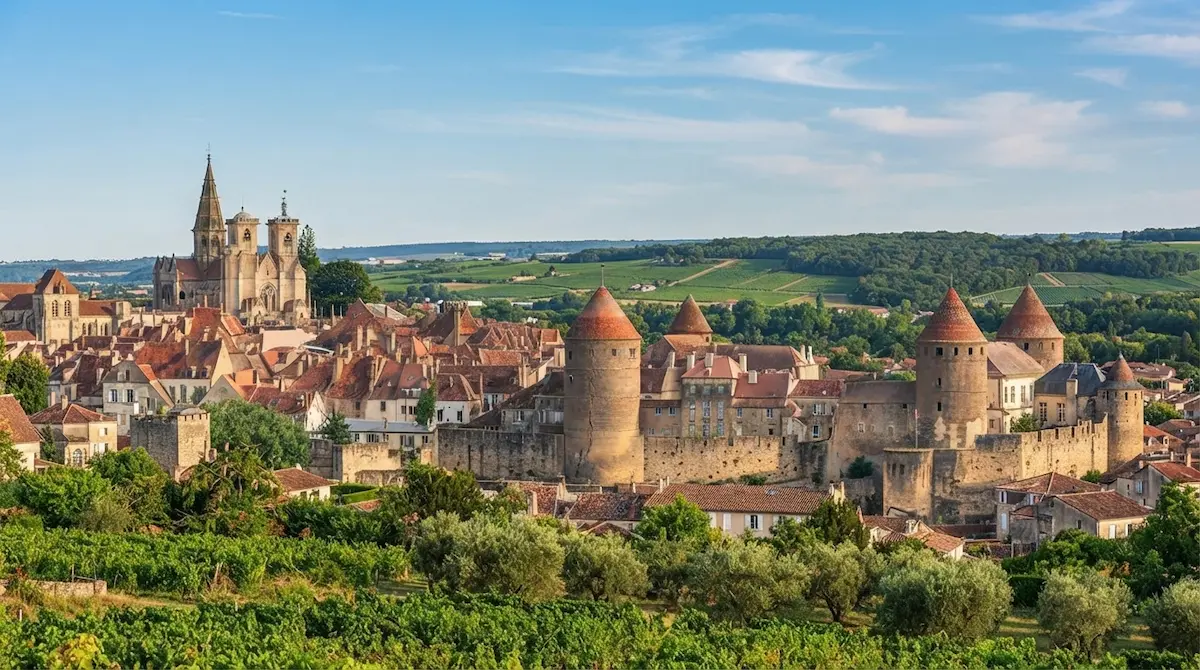
- Semur-en-Auxois (25 km): a classified medieval town with pink granite ramparts.
- Flavigny-sur-Ozerain (20 km): one of France’s Most Beautiful Villages, famous for its aniseed sweets.
- Fontenay Abbey (30 km): 12th-century Cistercian abbey, UNESCO-listed.
- Bussy-Rabutin Castle (10 km): home of the letter-writer exiled by Louis XIV.
Frequently asked questions
How long should I plan to visit the MuséoParc Alésia?
What is the best time to visit Alesia?
Is the site accessible by public transport?
Can you access the Vercingetorix statue?
Another question?
Write to usSources