
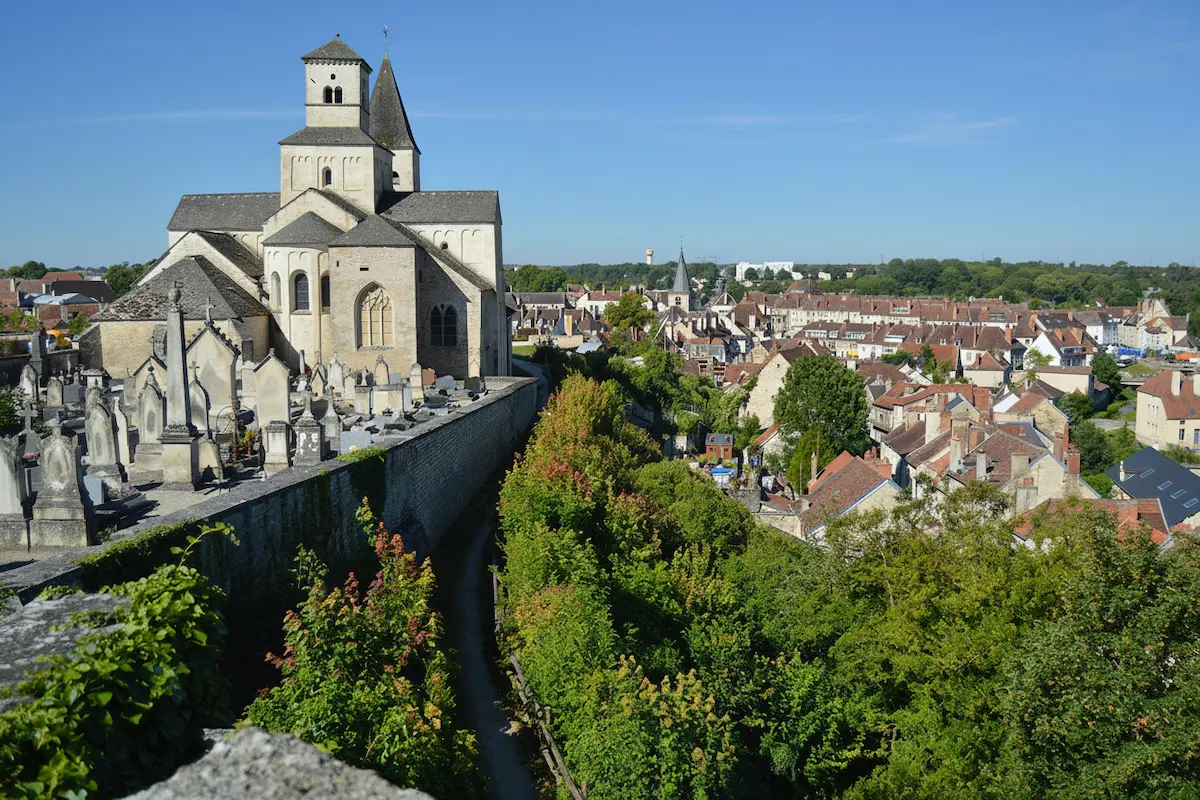


In brief: the first town crossed by the Seine, Chatillon-sur-Seine is the capital of Chatillonnais, labelled a Most Beautiful Detour of France. Its museum houses the Vix crater, its Douix spring is a 2,500-year-old Celtic sanctuary, and its historic centre boasts more than 20 listed or registered historic monuments.
Chatillon-sur-Seine is first and foremost about water. The Seine rises about fifteen kilometres upstream, the Douix springs forth at the foot of a cliff, and the town owes its Latin name Castellio to an ancient fortress of which only ruins remain on the heights. But those who stop for a detour discover far more than a simple stopover: a concentration of Celtic, Roman, medieval and contemporary history, all set in a preserved landscape of forests and valleys.
Classified among the Most Beautiful Detours of France, the town of 5,400 inhabitants is the natural gateway to the National Forest Park, France’s first lowland national park created in 2019. Between the sources of the Parisian river and the great Chatillon state forest, it packs within walking distance everything that makes Chatillonnais rich.
The Douix spring, a 2,500-year-old Celtic water sanctuary
The Douix is a Vauclusian resurgence: water bursts forth at the foot of a 30-metre-high tufa cliff, with an average flow of 600 litres per second, reaching 3,000 litres per second during floods. The cavity has been explored more than 200 metres upstream by diver-speleologists.
A continuous place of worship since the Iron Age
The Douix is no ordinary spring. It is the oldest Celtic water sanctuary known in Gaul. Archaeologists have identified nearly continuous offerings deposits from 650 BC to the present day:
- Final Hallstatt / Early La Tene (650-400 BC): nearly 350 iron and bronze fibulae, ceramics and miniature vases deposited by the Lingones
- Gallo-Roman period (1st c. BC - 2nd c. AD): stone ex-votos depicting busts, hands, legs and feet, as well as a statue of a woman carrying a child
- Modern era: bronze and gold pins, Virgin Mary medals, coins from the Republic to today
A statue of the Virgin and Child was placed above the spring entrance in the late Middle Ages, Christianising the former pagan sanctuary. The tradition of offerings continues: people still throw coins into the Douix, just as they did in Roman times.
Archaeological excavations
The major pumping operations of the 1990s (notably in 1996) allowed speleologists to explore the submerged conduit of the spring and uncover a significant archaeological deposit preserved in water for 2,500 years. Researchers identified Iron Age fibulae, Gallo-Roman stone ex-votos and coins from every period, forming one of the longest offering sequences ever documented at a water sanctuary in Western Europe. The results of these excavations have been published in international scientific journals.
Legends and traditions
In the 19th century, young girls would throw pins into the spring on Candlemas Day to learn their romantic fate. In nearby Montbard, people used human-shaped cakes, reminiscent of the ancient stone ex-votos. The name Douix itself is a Burgundian dialect word for this type of resurgence.
The site is a ten-minute walk from the town centre, along a path that follows the Seine. A small pond and a landscaped promenade make it a popular walking spot for locals.
The Saint-Vorles church, a 10th-century pre-Romanesque gem
Perched on the promontory overlooking the town, Saint-Vorles church is one of the oldest religious buildings in Burgundy. Its construction dates back to the end of the 10th century, making it an exceptional pre-Romanesque building, predating the great Romanesque wave of the 11th century.
The Saint-Bernard crypt
The crypt, traditionally called the Saint-Bernard crypt, is the church’s true archaeological treasure. Organised in three naves of four bays each, it preserves Palaeo-Christian elements from the 4th century. According to tradition, this is where Saint Bernard of Clairvaux received a few drops of milk from the Virgin Mary, the famous lactation miracle that made the church a pilgrimage site.
The crypt walls are covered with thousands of graffiti, testimonies of American and British soldiers from the First World War who came to pray before heading to the front. Fragments of a Roman column and a Latin funerary inscription reused in the flooring attest to the ancient occupation of the site.
Architecture and furnishings
The exterior facade features Lombard bands typical of Italianate Romanesque art. The interior, of great simplicity, is lit by whitewashed walls. The Gothic polygonal choir was added later.
The notable furnishings include an Entombment dated 1527 and listed as a historic monument, a sculpted masterpiece depicting Christ taken down from the cross, as well as a 16th-century diptych. The church houses several side chapels and preserves the relics of Saint Vorles, transferred to Chatillon as early as 868.
The historic centre and its listed heritage
Chatillon-sur-Seine has more than 20 listed or registered historic monuments, concentrated in an old town that blends medieval lanes with Renaissance mansions. The town has preserved its castle-town layout, historically divided between the Chaumont district on the heights and the Bourg in the valley.
Saint-Nicolas church and its stained glass
Built in the 12th century, Saint-Nicolas church features 16th-century listed stained glass windows depicting the Tree of Jesse and the pilgrims of Saint James. It stands on Place de la Republique, the beating heart of the town’s commercial life.
The castle of the Dukes of Burgundy
Only imposing ruins remain of the ancient fortress that gave the town its name. Perched on the rocky spur near Saint-Vorles, these 10th-12th century ruins offer panoramic views of the Seine valley.
Philandrier mansion and Renaissance house
A gem of Renaissance architecture, the Philandrier mansion (16th century) now houses the tourist office. Its ornate facade and French-style roof make it one of the most photographed buildings in town.
The Cordeliers convent
It was in this 13th-century convent that Marshal Joffre set up his headquarters in September 1914, during the Battle of the Marne. The building, a listed historic monument, now houses the Chatillonnais community of communes.
The Museum of Pays Chatillonnais and the Vix treasure
Housed since 2009 in the former Notre-Dame abbey founded in 1136 under the impetus of Saint Bernard, the Museum of Pays Chatillonnais is a Museum of France. Its centrepiece is the Vix treasure, discovered in 1953 in the tomb of a Celtic princess at the foot of Mount Lassois.
The Vix crater is the largest known ancient bronze vase in the Western world: 1.64 metres tall, 208 kilograms, crafted by Greek artisans in the 6th century BC. It is accompanied by the famous solid gold torc weighing 480 grams, an exceptional princely jewel, as well as a diadem, jewellery and elements of the princess’s chariot.
The museum also traces Chatillonnais history from Prehistory to the present day, with Gallo-Roman collections from the Vertillum site and everyday objects from the metallurgical industry that brought prosperity to the region in the 19th century.
History of Chatillon, from the Roman castrum to the 1814 congress
Occupation of the Chatillon site dates back to Antiquity. At the location of today’s Saint-Vorles church stood a Gallo-Roman castrum, probably a secondary fortification controlling the Seine valley on the border of Lingones territory. Fragments of columns and a Latin funerary inscription, reused in the crypt, are its most visible witnesses.
The medieval period
In the Middle Ages, the town developed around two poles: the Bourg in the valley, centred on Saint-Nicolas church and commercial activities, and the Chaumont district on the heights, centred on the castle of the Dukes of Burgundy and Saint-Vorles church. This duality is still readable in the town’s layout today. The Dukes of Burgundy used the castle as one of their secondary residences, and the town prospered through river trade on the Seine and iron craftsmanship.
The Congress of Chatillon (1814)
The most famous event in Chatillon’s history is undoubtedly the congress held there from 5 February to 19 March 1814. While Allied armies (Russia, Austria, Prussia, England) invaded France, their ambassadors gathered at the Hotel du Congres to negotiate with Napoleon’s envoy, Caulaincourt. The Emperor, who was fighting battles only a few leagues away, refused the proposed conditions, and the French campaign continued until the abdication of April 1814. A commemorative plaque in the hotel lobby recalls this diplomatic episode.
Chatillon in the 20th century
In September 1914, Marshal Joffre chose the Cordeliers convent as his headquarters to coordinate the Battle of the Marne. Orders for the counter-offensive that pushed back the Germans and saved Paris were launched from Chatillon. Later, in the 19th and 20th centuries, the town became an important industrial centre with the Chatillon-Commentry ironworks company, specialising in metallurgy.
Hiking and activities around Chatillon
Chatillon-sur-Seine is not just a town of history: it is also the ideal starting point for exploring Chatillonnais on foot or by bike.
Trails around town
Several marked circuits start directly from the town centre. The Douix circuit is a loop around the spring and the pond. The Mont Lassois trail leads to the Celtic oppidum where the Vix treasure was discovered.
At the heart of the National Forest Park
Chatillon is one of the gateway towns to the National Forest Park, created in 2019. This park protects a 56,000-hectare forest massif spread between Cote d’Or and Haute-Marne. From Chatillon, you can directly access the Chatillon state forest, the largest forest in Cote d’Or with its 9,000 hectares of beech and oak woodlands, crisscrossed by marked trails suitable for hiking, mountain biking and wildlife observation (deer, roe deer, wild boar and over 120 bird species).
Practical information
Chatillon-sur-Seine is located 80 kilometres north of Dijon, 45 minutes from Troyes and one hour from Langres. The station, opened in 1864 on the Paris-Dijon line, has not served passenger traffic since 1994; Mobigo network coaches connect the town to neighbouring communes. The Saturday morning market is an opportunity to discover Chatillonnais local produce.
The tourist office, housed in the Philandrier mansion (1 rue du Bourg), provides hiking maps and information on guided tours. Numerous marked trails start from the town centre, including the Douix circuit and loops in the Chatillon forest.
For a gourmet break, the town centre offers several restaurants featuring Burgundian specialities: parsley ham, eggs in meurette sauce and local cheeses.
Frequently asked questions
How long should I spend visiting Chatillon-sur-Seine?
Is the Museum of Pays Chatillonnais free?
What is the best season to visit Chatillonnais?
Another question?
Write to usSources