


In short: Dijon deserves more than a simple stopover between two trains. With 48 hours ahead, you have time to see the essentials without rushing: the Palais des Ducs, the Chouette trail, the Halles, a museum and a cellar tasting. Here is the hour-by-hour itinerary for a successful weekend, with real distances and tips for each stage.
Dijon is a city lived on foot. Its historic centre, one of France’s largest with 97 hectares listed as a protected sector, concentrates the essential heritage within less than 2 kilometres of the Palais des Ducs. No need for a car or public transport to cover it: walking shoes are enough. This guide offers an optimised two-day route, with realistic times and alternatives to adapt the programme to your interests.
Day 1: Dijon’s great heritage
Morning: Palais des Ducs and Tour Philippe le Bon
Palais des Ducs and Tour Philippe le Bon, details
Start with the monument that dominates the city: the Palais des ducs et des États de Bourgogne, a vast architectural complex built between the 14th and 18th centuries. It is one of Europe’s largest palaces, and today houses Dijon town hall and the Musée des Beaux-Arts. The guided visit of the Tour Philippe le Bon, 46 metres high, is the best starting point for understanding the city’s topography. The 316 spiral steps lead to a panoramic terrace that offers, on a clear day, a 360-degree view over glazed-tile roofs and the Côte de Nuits vineyards to the south. Allow 45 minutes for the climb, guided commentary and descent (rates and booking on destinationdijon.com). Note: the tower is only visited with a guide, by mandatory booking, with a maximum of 18 people per slot, weekend places go fast, book early.
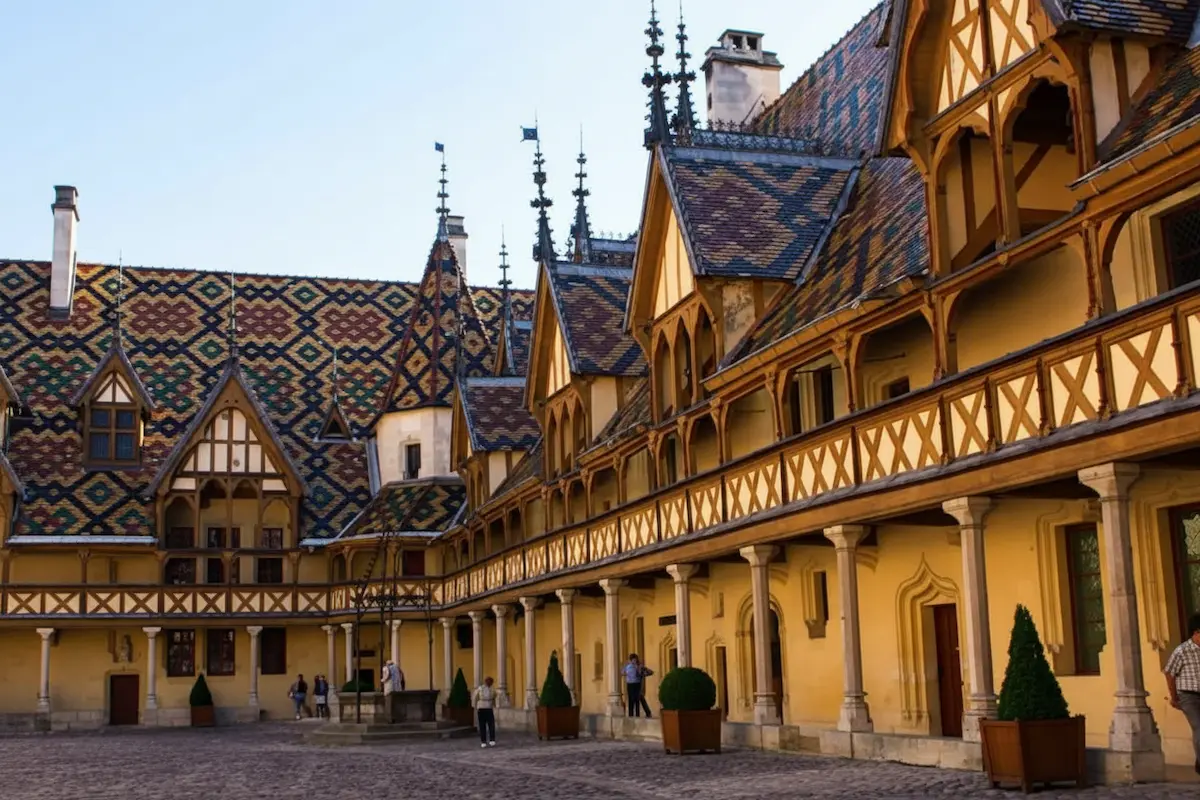
Then go down into the palace courtyard of honour to admire the polychrome glazed-tile roof that makes the city’s reputation. The geometric lozenge motifs in green, yellow, red and black are typical of 15th-century Burgundian architecture and appear on several monuments in the city.
Late morning: the Musée des Beaux-Arts
The Musée des Beaux-Arts de Dijon, in the right wing of the palace, is one of France’s richest museums. Its collection runs from Egyptian antiquity to contemporary art, with a strong focus on Northern painting and sculpture (15th–16th centuries) and French schools (17th–19th centuries). The highlight remains the Salle des Gardes, where the tombs of Dukes of Burgundy Philip the Bold and John the Fearless are displayed, masterpieces of 15th-century Burgundian sculpture. Entry is free for all, so you can stay as long as you like without feeling rushed. Allow 1.5 hours for a full visit of the permanent collections.
Lunch: the Halles centrales and Rue des Godrans
At midday, head for the Halles centrales de Dijon, built between 1873 and 1875. Contrary to a stubborn legend, they are not the work of Gustave Eiffel (the final design was by architect F. Gouet and engineer Louis-Clément Weinberger). They house many food traders and several takeaway food stalls where you eat fresh produce on the spot: jambon persillé, oeufs en meurette, escargots de Bourgogne. The market is open Tuesday, Thursday, Friday and Saturday from 7 am to 1 pm, on Saturdays, more than 200 stalls also spill onto the neighbouring pedestrian street, for the liveliest appointment of the week. For a more formal lunch, Rue des Godrans and Place François-Rude are full of bistros and brasseries in a reasonable price range.
Afternoon: Chouette trail
The afternoon is devoted to the Chouette trail, the pedestrian tourist route that winds through the historic centre across 22 stages, marked by bronze arrows set in the pavement and stamped with an owl, the city’s emblem. The official start is at the Jardin Darcy. The 3.7-kilometre circuit takes about 1 to 1.5 hours of walking without stopping, but allow twice that if you pause at each site. The trail guide booklet is on sale at the Tourist Office, 11 rue des Forges.
Among the must-see stages: Notre-Dame church (13th century), a masterpiece of Burgundian Gothic whose façade holds the famous small carved owl, touching this owl with the left hand is said to bring luck, according to Dijon tradition. Notre-Dame’s façade, with its three portals and two storeys of openwork galleries, is one of the finest examples of Rayonnant Gothic in Burgundy. Inside, the 13th-century stained glass and the Black Madonna (Notre-Dame de Bon-Espoir) deserve a stop.
Continue to Rue Verrerie, one of Dijon’s oldest streets, lined with half-timbered houses and 15th- and 16th-century townhouses. Place Émile-Zola, where the flower market is held on Sunday morning, offers a photographic viewpoint over the city’s roofs.
Saint-Michel church, another stage on the trail, combines Flamboyant Gothic and Renaissance styles. Its triple-pediment façade, built between 1497 and 1529, is unique in France. It has been listed as a Historic Monument since 1840, one of the country’s very first heritage protections.
Evening: dinner and Dijon gastronomy
In the evening, Dijon offers a wide choice of tables. For a first approach to Burgundian gastronomy, Rue des Godrans and Place de la Libération concentrate a dense, varied offer. Specialities not to miss: boeuf bourguignon (beef stew in Burgundy red wine), oeufs en meurette (poached in red-wine sauce), jambon persillé (ham in parsley jelly) and escargot de Bourgogne (cooked in parsley butter). For cheese, Époisses AOP, with its powerful character, is the most famous of Burgundian cheeses.
End the evening with a stroll on Place de la Libération, the former Place Royale designed by Jules Hardouin-Mansart, beautifully lit at night, with its hemicycle of classical façades framing the theatre.
Day 2: between gastronomy, culture and wandering
Morning: Cité de la gastronomie and antique quarter
The second day begins with a visit to the Cité internationale de la gastronomie et du vin, opened in 2022 in the former general hospital. This vast complex mixes a museum trail on flavours and terroirs, tasting workshops, a regional-product shop and an auditorium. The permanent trail explores the history of French gastronomy, from medieval banquets to the contemporary table, with a focus on Burgundy’s emblematic products: wine, mustard, pain d’épices, blackcurrant, cheeses. Allow 1.5 hours for the visit. The wander through the Cité is free; only access to the permanent exhibitions is charged (count about ten euros per adult).
On leaving, walk on to the Jardin de l’Arquebuse, Dijon’s botanical garden, which also houses the Natural History Museum and the Planetarium. It is a quiet place for a pause between visits, with its medicinal plant beds, rose garden and arboretum. Entry is free.
Lunch: Dijon mustard and local products
For Saturday lunch, a stop at the Halles centrales is essential if you missed them the day before. Otherwise, Maison Millière (10 rue de la Chouette), a listed 15th-century building, offers a traditional Burgundian menu in a historic setting. Nearby, Moutarderie Fallot (7 rue Bossuet), Dijon’s last independent artisan mustard works, offers tastings and the sale of mustards in varied flavours. Its production workshop can be visited by booking.
Afternoon: Chartreuse de Champmol or free historic quarter
Two options for the afternoon. The first: visit the Chartreuse de Champmol, the former monastery founded by Philip the Bold in 1383 to house the tombs of the Dukes of Burgundy. All that remains today is the church portal and the Puits de Moïse, a masterpiece by sculptor Claus Sluter (1396–1405), considered one of the peaks of Gothic sculpture. The site is about 25 to 30 minutes on foot from the centre (15 minutes from the station), or 10 minutes by bus (line Liane 3, CHS La Chartreuse stop). The Puits de Moïse and the chapel can be visited freely and free of charge, every day from 9 am to 6 pm; guided tours are also offered by the Tourist Office.
The second option, if you prefer to stay in the centre: wander the pedestrian streets of the historic quarter, Rue de la Liberté and Rue des Forges, where local craft shops, specialist bookshops and tasting cellars concentrate. Several centre cellars and wine bars, such as Caveau de la Chouette (39 rue des Godrans) or La Source des Vins (facing Saint-Bénigne cathedral), offer Burgundy wine tastings without booking, with a selection covering all appellations of the Côte de Nuits and Côte de Beaune.
Late afternoon: viewpoint from Jardin Darcy
End the weekend with a stroll in Jardin Darcy, at the entrance to the centre, which offers a perspective on the Palais des Ducs and the city’s roofs. The monumental fountain, the bust of engineer Henry Darcy and the polar bear by François Pompon (1937 replica) make it one of Dijon’s most photographed places.
Departure: Gare de Dijon-Ville
The weekend ends at Dijon-Ville station, 15 to 20 minutes on foot from the Palais des Ducs (10 minutes from Place Darcy). TGV links connect Paris in 1 h 35 and Lyon in about 1 h 30. The station has left-luggage for those who want to enjoy Sunday morning before taking a train early afternoon.
The must-sees if you have more time
If you have a few extra hours or a third day, here is what can be added: MuséoParc Alésia (50 minutes by road), Fontenay Abbey (UNESCO, 1 hour by road), or an excursion on the Route des Grands Crus as far as Beaune (25 minutes by train). See our detailed itinerary for the Route des Grands Crus in 3 days.
Estimated budget for a weekend in Dijon
Here is a rough idea for two days, per person: 2–3-star hotel in the centre, €80 to €120 per night; meals (lunch + dinner), €50 to €80 per day; visits (Tour Philippe le Bon + Cité de la gastronomie), about €20; transport (tram, TER if excursion to Beaune), €10 to €30. Total for a full weekend: between €200 and €350 per person, depending on accommodation and restaurant choice.
Frequently asked questions
Can you visit Dijon on foot over a weekend?
Do you need to book for the Tour Philippe le Bon?
What is the best day for a weekend in Dijon?
Another question?
Write to usSources
- Dijon Tourist Office
- Chouette trail - Dijon Tourist Office
- Musée des Beaux-Arts de Dijon
- Wikipedia - Palais des ducs de Bourgogne
- Wikipedia - Tour Philippe le Bon
- Cité internationale de la gastronomie et du vin
- Jardin de l'Arquebuse - City of Dijon
- Wikipedia - Halles centrales de Dijon
- SNCF - Gare de Dijon-Ville
- Divia - Dijon public transport
- Wikipedia - Église Saint-Michel de Dijon
- Insee - Dijon: key figures